


Aqua Peel Machine Certification and Regulatory Guide
- Understanding Aqua Peel Technology and Market Use
- What is an aqua peel machine?
- Clinical indications and typical users
- Safety considerations and contraindications
- Regulatory Frameworks by Region
- United States: FDA pathways and device classification
- European Union: MDR and CE marking
- China and other markets
- Technical and Clinical Evidence Requirements
- Risk classification and essential requirements
- Clinical performance and safety data
- Standards: electrical safety, biocompatibility, EMC
- Steps to Certification, Market Access & Post-market Obligations
- Product development, QMS and documentation
- Submission process and typical timelines
- Post-market surveillance, vigilance and labeling
- Practical Checklist: From Prototype to Market
- Design and risk mitigation
- Testing and clinical evidence
- Regulatory submission and market launch
- Why choose an experienced OEM/ODM partner: A case example
- Brief about Guangzhou Huimain Technology Co., Ltd.
- Certifications, product range and global reach
- Competitive strengths and why it matters
- FAQ
- 1. Is an aqua peel machine considered a medical device?
- 2. What certifications are essential for selling aqua peel machines in the EU and US?
- 3. Do I need clinical trials for an aqua peel device?
- 4. What are the common test standards required?
- 5. How long does certification usually take?
- 6. Can I import an aqua peel machine without local testing?
Aqua peel machines (also called hydrofacial or hydrodermabrasion devices) combine controlled fluid delivery, suction, and topical serums to exfoliate, cleanse, and infuse the skin. Because they are active aesthetic devices that interact with skin and fluids, they fall under medical/aesthetic device regulations in many jurisdictions. This guide provides a practical, step-by-step regulatory and certification roadmap—covering the US, EU, China and global markets—so manufacturers, distributors and clinic buyers can understand classification, required technical/clinical evidence, testing standards (electrical safety, biocompatibility), quality management system expectations, labeling, and post-market surveillance obligations. Where appropriate we reference authoritative sources to help you verify requirements and plan compliance effectively.
Understanding Aqua Peel Technology and Market Use
What is an aqua peel machine?
An aqua peel machine (hydrofacial machine) is a device that uses a pressurized saline or serum solution plus a vacuum/suction head and rotating or vortex tips to perform non-invasive exfoliation, manual atraumatic peeling, pore extraction and topical infusion. Unlike abrasive microdermabrasion, aqua peel devices use fluid dynamics to dislodge debris and deliver serums, reducing mechanical trauma while addressing concerns such as dull skin, enlarged pores, and mild acne. For an overview of device types and clinical uses, see professional sources such as dermatology reviews and device manufacturer technical briefs.
Clinical indications and typical users
Common indications include superficial exfoliation, sebum and blackhead extraction, mild resurfacing, and topical infusion for moisturization or antioxidant delivery. Typical users range from licensed dermatologists and medical aestheticians in clinics to portable home-use variants designed for consumer use (with different power and safety profiles). Understanding intended use is essential because it directly affects regulatory classification and the evidence required.
Safety considerations and contraindications
Key risks include skin irritation, burns (rare, when heated serums or energy adjuncts used), infection (if reusable tips are not effectively disinfected), and adverse reactions to active serums. Contraindications generally include active infection, open wounds, recent isotretinoin use, or certain dermatological conditions. These clinical safety points must be documented in the Instructions for Use (IFU) and supported by risk analysis and clinical data.
Regulatory Frameworks by Region
United States: FDA pathways and device classification
In the US, the Food and Drug Administration (FDA) regulates devices that claim therapeutic or diagnostic effects. Many aesthetic devices are regulated as medical devices. The FDA's device classification and 510(k) or De Novo pathways depend on intended use and technology. For devices that are similar to predicate devices, a 510(k) premarket notification is typical; novel technology may require De Novo classification or even PMA if high risk. See the FDA device center for details: FDA Medical Devices.
European Union: MDR and CE marking
The EU Medical Device Regulation (MDR 2017/745) significantly tightened requirements for clinical evidence, technical documentation, and post-market surveillance compared with the old MDD. Under MDR, device classification rules (Class I to III) determine conformity assessment route and notified body involvement. Many powered aesthetic devices fall into Class IIa or higher depending on intended use and invasiveness. CE marking requires a conformity assessment, technical file, clinical evaluation report (CER), and a quality management system such as ISO 13485. See the European Commission overview: EU MDR information.
China and other markets
China's National Medical Products Administration (NMPA) regulates medical devices; classification and local testing requirements can differ from US/EU pathways and often require a China-local clinical evaluation or test reports. Other markets (e.g., Canada, Australia, Brazil) have their own classifications and may accept evidence from recognized authorities if dossier and labeling meet local requirements. Check the relevant authority (e.g., NMPA: NMPA).
Technical and Clinical Evidence Requirements
Risk classification and essential requirements
Regulatory authorities evaluate the device based on intended purpose, invasiveness, energy sources, and interaction with the body. Aqua peel machines typically are non-energy or low-energy devices that carry fluid and mechanical suction; however, when combined with electrical controls, LED, RF, or heat, the classification can change. Device designers must perform a formal risk analysis (ISO 14971) and demonstrate conformity with essential safety and performance requirements (EU MDR Annex I; FDA's general device controls).
Clinical performance and safety data
Clinical evidence should demonstrate that the device performs as intended and is safe for the indicated population. Evidence may include literature reviews of equivalent devices, bench testing (bench-top performance), usability testing, and clinical investigations when literature and comparative data are insufficient. The MDR emphasizes a robust Clinical Evaluation Report (CER); similarly, FDA reviewers expect reasonable clinical data for novel claims. When possible, cite peer-reviewed studies and provide reproducible study protocols. Guidance: ISO 14155 for clinical investigation design and conduct.
Standards: electrical safety, biocompatibility, EMC
Common standards include:
- IEC 60601 series for electrical safety and electromagnetic compatibility (EMC) of medical electrical equipment (or applicable national equivalents).
- ISO 10993 for biological evaluation and biocompatibility of materials contacting skin or tissues.
- IEC 62366 for usability engineering to reduce user error.
Steps to Certification, Market Access & Post-market Obligations
Product development, QMS and documentation
Implement an ISO 13485-compliant Quality Management System early in development to control design, supplier management, risk management (ISO 14971), and production processes. Key documentation includes design history file (DHF), device master record (DMR), risk management file, clinical evaluation, IFU and labeling, and test reports. Certification to ISO 13485 streamlines many regulatory submissions and demonstrates manufacturing controls. ISO 13485 reference: ISO 13485.
Submission process and typical timelines
Timelines vary by region and device class. The table below summarizes typical pathways and approximate timelines (indicative ranges):
| Region | Authority / Route | Typical Classification | Key Requirements | Indicative Timeline |
|---|---|---|---|---|
| United States | FDA (510(k), De Novo, PMA) | Class II (commonly) or De Novo if novel | 510(k): substantial equivalence, bench/biocompatibility; De Novo: more clinical data | 3–18 months (510(k) often 3–9 mo; De Novo longer) |
| European Union | MDR + Notified Body & CE | Class I–III (Class IIa/IIb common for powered aesthetic devices) | Technical file, CER, NB audit, ISO 13485 | 6–24 months (depends on NB workload & completeness) |
| China | NMPA registration & local testing | Class II/III possible | Local testing, potential local clinical data, QMS | 9–24 months |
Note: timelines are influenced by the completeness of documentation, third-party lab testing availability, notified body capacity, and whether device claims are novel.
Post-market surveillance, vigilance and labeling
Post-market obligations include vigilance reporting (serious incidents), trend analysis, complaint handling, field safety corrective actions (FSCA), periodic safety update reports (PSUR) under MDR, and maintaining technical documentation. Unique Device Identification (UDI) requirements apply in many jurisdictions and help trace devices. Maintain a robust post-market surveillance plan and be prepared for regulatory inspections.
Practical Checklist: From Prototype to Market
Design and risk mitigation
- Define intended use and target population clearly; it determines regulatory route.- Conduct comprehensive risk analysis (ISO 14971) to mitigate infection, electrical, mechanical and chemical risks.- Choose materials with documented biocompatibility (ISO 10993) and design for cleaning/disinfection or single-use tips as appropriate.
Testing and clinical evidence
- Perform bench performance testing: flow rates, suction force, pressure limits, tip wear, and serum delivery consistency.- Complete electrical safety and EMC testing per IEC 60601 where applicable.- Compile clinical evidence: literature review, pilot clinical studies or usability testing depending on claims.
Regulatory submission and market launch
- Prepare technical file (EU) or 510(k)/De Novo dossier (US) with all test reports, risk management, and IFU.- Implement ISO 13485 QMS and consider third-party auditing early.- Plan labeling, service, and spare parts documentation and local language IFUs for intended markets.
Why choose an experienced OEM/ODM partner: A case example
Brief about Guangzhou Huimain Technology Co., Ltd.
Guangzhou Huimain Technology Co., Ltd. is a high-tech enterprise specializing in the research, development, production, and after-sales service of professional beauty machines and home-use devices. Operating from a 3,000-square-meter facility, the company is driven by a strong technical team where over 60% of staff hold higher education degrees. Dedicated departments for purchasing, clinical testing, and engineering enable continuous R&D investment and rigorous quality control.
Certifications, product range and global reach
Huimain has earned CE certification, SGS approval, and numerous patents. Their high-quality products are distributed across China, Southeast Asia, the Middle East, Europe, and North America. Following OEM and ODM routes, they design and manufacture medical and beauty equipment for salons and distributors worldwide. Key products include Cryolipolysis machines, Ems sculpting machines, Plasma machines, Shockwave machines, HIFU machines, Hydrofacial machines, Cavitation vacuum machines, Laser hair removal, Tattoo removal devices, and Microneedle machines. Company website: https://www.huimainbeauty.com/. For inquiries: coco@gzhuimain.com.
Competitive strengths and why it matters
Huimain's strengths are end-to-end R&D, in-house clinical testing, and an ISO-style quality focus that aligns with global regulatory expectations. For companies seeking compliant aqua peel (hydrofacial) devices, partnering with a manufacturer that understands CE, SGS testing, and clinical evidence generation shortens time-to-market and reduces regulatory risk. Their combined product portfolio and patent-backed innovations also support differentiating features while maintaining cost competitiveness.
FAQ
1. Is an aqua peel machine considered a medical device?
It depends on intended use and claims. If the device is marketed for medical indications (e.g., treating acne, wound care), most authorities will consider it a medical device. Even cosmetic claims can trigger regulation if the device has active mechanical or electrical functions. Determine the intended use first to decide the regulatory pathway.
2. What certifications are essential for selling aqua peel machines in the EU and US?
EU: CE marking under MDR with a supporting technical file and likely a Notified Body assessment for Class IIa/IIb devices. US: FDA clearance via 510(k) or De Novo depending on novelty and predicate devices. ISO 13485 is broadly useful for quality management recognition.
3. Do I need clinical trials for an aqua peel device?
Not always. If there is sufficient literature and equivalence to an existing device, bench and clinical literature may suffice. However, novel claims, new technologies, or significant changes in indications often require clinical investigations per ISO 14155.
4. What are the common test standards required?
Common standards include IEC 60601 (electrical safety/EMC), ISO 10993 (biocompatibility), ISO 13485 (QMS), IEC 62366 (usability) and relevant national variations. Specific tests depend on device design and materials.
5. How long does certification usually take?
Timelines vary by region: 3–9 months for many 510(k) clearances (US), 6–24 months for CE under MDR (EU), and 9–24 months for NMPA (China). Completeness of documentation and notified body availability are major factors.
6. Can I import an aqua peel machine without local testing?
Some countries require local testing or local agent representation. While some regulators accept overseas test reports and certificates, confirm local requirements (e.g., national safety marks, language-specific IFUs, importer responsibilities).
If you need help assessing your device's intended classification, preparing technical documentation, or choosing a compliant OEM/ODM partner, contact Guangzhou Huimain Technology Co., Ltd. for product options, technical support and compliance-ready manufacturing. Visit Huimain or email coco@gzhuimain.com to discuss OEM/ODM opportunities and view our Hydrofacial (aqua peel) machine and other product lines.
References and further reading: FDA Medical Devices (https://www.fda.gov/medical-devices), EU MDR information (https://ec.europa.eu/health/medical-devices-new-regulations_en), ISO 13485 (https://www.iso.org/standard/59752.), NMPA (http://www.nmpa.gov.cn), SGS (https://www.sgs.com/).
台式黄金射频微针
What is an RF micro needle machine?
It is a device that combines microneedling with radio frequency energy to stimulate deep collagen, tighten skin, and treat acne scars.
OL-164
What are the main treatment effects?
Deep cleansing, blackhead removal, hydration, anti-aging, and skin tone improvement.
OL-153
What skin types can the Hydro Dermabrasion Water Oxygen Machine treat?
It’s suitable for all skin types, including sensitive and dry skin, offering deep hydration and exfoliation.
Portable EMS RF Body Sculpting Machine
Can this machine be used at home?
Yes, it’s designed for both salon professionals and home users with easy-to-use controls.
3 in 1 808+Pico+DPL
Is training required to operate this device?
Basic operator training is recommended, and the machine includes an intuitive interface to support easy learning.

CO2 Fractional Laser Machine – Professional Wrinkle Removal & Skin Resurfacing Device
The CO2 Fractional Laser Machine is a multifunctional aesthetic device designed for professional clinics and beauty salons. Using advanced fractional CO2 laser technology, it effectively targets acne scars, freckles, pigmentation, nevi, and deep wrinkles. Additionally, it provides non-invasive skin rejuvenation, vaginal tightening, and intimate beautification. This professional CO2 laser equipment combines precision, safety, and powerful energy output to deliver outstanding anti-aging and dermatological results.

5-in-1 40K Cavitation Vacuum Machine for Body Slimming & Fat Reduction
The 5-in-1 40K Cavitation Vacuum Machine is a professional body shaping system designed for fat reduction, cellulite smoothing, and overall body contouring. Using 40KHz ultrasonic cavitation, this device breaks down stubborn fat cells, while vacuum suction improves lymphatic drainage and accelerates toxin removal.
With multiple RF tightening handles, the machine stimulates collagen regeneration and helps lift and firm loose areas of the body. Compact, powerful, and easy to operate, it is the perfect solution for beauty salons, spa centers, and slimming studios seeking fast and visible fat-reduction results.
This cavitation vacuum machine is built to deliver safe, non-invasive treatments with no downtime—making it a top choice for body contouring professionals.

6-in-1 Multifunctional Beauty and Weight Loss Machine | Cavitation, RF, Vacuum PDT, EMS, Laser Slimming Equipment for Professional Use
The 6-in-1 Multifunctional Beauty and Weight Loss Machine is a professional-grade device designed for salons, clinics, and distributors. Combining six advanced technologies—cavitation, RF (radio frequency) for face & body, vacuum RF PDT, BIO/EMS microcurrent, and laser lipo pads—this device offers comprehensive body contouring, fat reduction, skin tightening, and anti-aging treatments.
It provides businesses with an all-in-one solution to expand service offerings, attract more clients, and achieve a rapid return on investment.
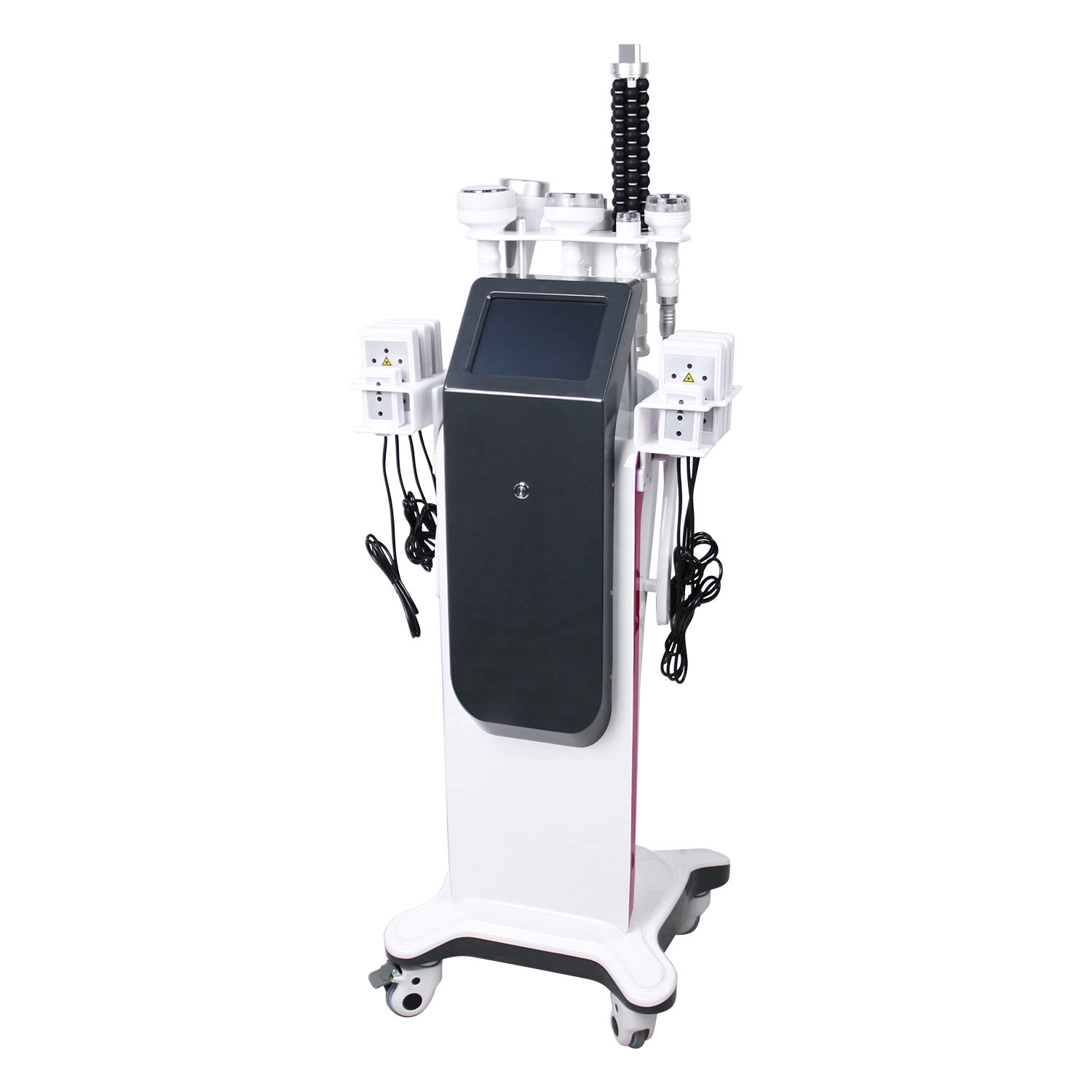
Professional 6-in-1 Cavitation Vacuum Machine for Body Contouring & Slimming Treatment
The 6-in-1 Cavitation Vacuum Machine is a professional body contouring system designed for salons and spas seeking high-performance slimming solutions. This machine integrates 40K ultrasonic cavitation, vacuum suction, RF technology, and laser lipolysis to target stubborn fat, enhance lymphatic drainage, tighten the skin, and contour the body shape effectively.
Equipped with multiple ergonomic handles and a smart touch screen, this cavitation vacuum machine provides a comfortable and efficient experience for both operators and clients. It is ideal for full-body treatments including abdomen, arms, legs, waistline, hips, and back.
Perfect for beauty salons, spas, and aesthetic centers that want to offer non-invasive fat reduction and body-sculpting services.
Get more information
If you have any comments or good suggestions, please leave us a message; later our professional staff will contact you as soon as possible.
Let's Talk
Stay in touch with us for cutting-edge beauty solutions, professional guidance, and customized service.
Contact


Room 307, Building A, Huilong International E-commerce Industrial Park, No. 10 Xipengling Road, Helong Street, Baiyun District, Guangzhou, China
© 2025 HUIMAIN. All Rights Reserved. Privacy Policy | Terms and Conditions | Sitemap
Facebook
Instagram
Medical beauty equipment factory
huimain Medical beauty equipment factory
beauty machine supplier
Whatsapp: +8619124004543