


CE vs FDA: Certification for CO2 Fractional Laser Machines
- Understanding regulatory frameworks for medical lasers
- What the EU MDR and CE marking mean for lasers
- What FDA regulation covers in the United States
- Common international standards that matter
- CE vs FDA: Key differences for CO2 fractional laser machines
- Regulatory classification and impact
- Clinical evidence and testing expectations
- Post-market surveillance and vigilance
- Practical steps to achieve certification and avoid common pitfalls
- Step 1: Define intended use and risk class clearly
- Step 2: Establish a compliant QMS and technical documentation
- Step 3: Laboratory testing and clinical data strategy
- Comparative table: CE (EU MDR) vs FDA (510(k)/PMA) for CO2 fractional laser
- Manufacturing, competitiveness and choosing a compliant partner
- What I look for in a manufacturing partner
- Why Guangzhou Huimain Technology is a strong option
- Certification track record and product portfolio
- Cost, timeline and go-to-market considerations
- Budgeting realistically
- Speed to market vs breadth of claims
- Risk mitigation and regulatory strategy
- Final recommendations from an industry perspective
- Start with clear product definition
- Engage regulators and notified bodies early
- Partner with experienced manufacturers
- Frequently Asked Questions (FAQ)
- 1. Does CE marking alone allow me to sell a CO2 fractional laser machine in the United States?
- 2. How much clinical data is typically required for a co₂ fractional laser machine?
- 3. What technical tests are mandatory prior to CE or FDA submission?
- 4. Can an OEM/ODM manufacturer help with regulatory submissions?
- 5. How long does it take to get CE or FDA clearance for an ablative laser?
- 6. Is ISO 13485 mandatory?
I’m a seasoned consultant in the beauty-device sector, and I often advise manufacturers and distributors on regulatory strategy for co₂ fractional laser machine products across regions including the EU, the United States, and Asia. This article provides a practical, evidence-based comparison of CE marking under the EU Medical Device Regulation (MDR) and FDA clearance/approval in the US, outlines the technical and clinical requirements you should budget for, and gives hands-on steps to expedite market entry while maintaining compliance and patient safety.
Understanding regulatory frameworks for medical lasers
What the EU MDR and CE marking mean for lasers
In the EU, medical lasers such as CO2 fractional lasers fall under the Regulation (EU) 2017/745 — the Medical Device Regulation (MDR). CE marking demonstrates conformity with the MDR and allows market access across the European Economic Area. Key references: European Commission MDR overview (ec.europa.eu/health/md_sector/overview_en).
What FDA regulation covers in the United States
The U.S. Food and Drug Administration (FDA), via its Center for Devices and Radiological Health (CDRH), regulates medical lasers as devices. Depending on intended use and risk, CO2 fractional lasers may go through a 510(k) premarket notification (substantial equivalence) or a more rigorous Premarket Approval (PMA) pathway for higher-risk claims. Authoritative resource: FDA medical devices pages (fda.gov/medical-devices).
Common international standards that matter
Both jurisdictions expect compliance with recognized technical and quality standards: ISO 13485 for quality management systems (iso.org/standard/59752.), IEC 60601 series for electrical safety and EMC, and ISO 10993 for biocompatibility where applicable. Meeting these standards strengthens dossiers for both CE and FDA submissions.
CE vs FDA: Key differences for CO2 fractional laser machines
Regulatory classification and impact
CO2 fractional laser machines are generally classified as higher-risk medical devices because they deliver ablative energy and interact directly with tissue. Under MDR, many ablative and resurfacing lasers fall into Class IIa or Class IIb depending on indication and invasiveness; in the U.S., risk classification informs whether a 510(k) or PMA is required. Classification determines clinical evidence and conformity assessment routes.
Clinical evidence and testing expectations
The EU under MDR expects a clinical evaluation report (CER) proportional to risk. If sufficient clinical data already exist (published studies or equivalent device data), you may rely on literature and equivalence; if not, clinical investigations in the EU are required. The FDA frequently requires clinical data for new indications or novel devices, and for many ablative lasers, clinical studies form part of the 510(k) or PMA submission. See FDA 510(k) guidance (fda.gov/medical-devices/premarket-notification-510k).
Post-market surveillance and vigilance
Both regulators emphasize post-market surveillance. MDR introduces a more prescriptive Post-Market Surveillance (PMS) plan and Periodic Safety Update Report (PSUR) for higher-risk devices. The FDA enforces Medical Device Reporting (MDR) and may require post-approval studies or 522 postmarket surveillance studies. A robust PMS strategy should be built into your QMS early.
Practical steps to achieve certification and avoid common pitfalls
Step 1: Define intended use and risk class clearly
Start by precisely drafting intended use statements and indications for use. The wording determines regulatory pathway — cosmetic vs medical claims drastically change expectations. I always advise manufacturers to document clinical rationale and risk mitigation measures tied to the intended use.
Step 2: Establish a compliant QMS and technical documentation
Implement ISO 13485-aligned processes, document design controls, risk management (ISO 14971), verification/validation, labeling, and clinical evidence. For CE, prepare the Technical File or Design Dossier; for FDA, prepare a 510(k) or PMA dossier according to guidance. Resource: ISO 13485 overview (iso.org/standard/59752.).
Step 3: Laboratory testing and clinical data strategy
Plan IEC 60601 electrical and EMC testing, laser-specific safety (e.g., IEC 60825 laser safety standards), and biocompatibility testing. If clinical studies are needed, align protocols with regulatory expectations and Good Clinical Practice (GCP). Early engagement with a notified body (EU) or a pre-submission meeting with FDA (US) can clarify requirements and reduce rework.
Comparative table: CE (EU MDR) vs FDA (510(k)/PMA) for CO2 fractional laser
| Aspect | CE (EU MDR) | FDA (US) |
|---|---|---|
| Regulatory authority | European Commission; conformity assessed by Notified Bodies under MDR (MDR overview) | U.S. Food and Drug Administration (CDRH) (FDA) |
| Typical device class | Class IIa / IIb (often IIb for ablative lasers) | Class II (510(k)) or Class III (PMA) depending on claims and risk |
| Clinical data expectation | Clinical Evaluation Report; clinical investigations if equivalence or literature insufficient | Depends on predicate device; often clinical data required for novel devices or new indications |
| Conformity assessment | Notified Body audit and review; technical documentation & QMS required | 510(k) submission (substantial equivalence) or PMA (scientific evidence) review by FDA |
| Standards typically required | ISO 13485, IEC 60601, IEC 60825, ISO 10993 | Same technical standards; FDA recognizes consensus standards (see FDA website) |
| Timeframe (typical) | 6–18 months depending on Notified Body workload and clinical needs | 3–12+ months for 510(k); PMA can take 12–36 months depending on data |
| Post-market obligations | PMS plan, vigilance reporting, UDI, PSUR | MDR reports (Medical Device Reports), potential post-approval studies, UDI |
Sources: EU MDR overview (ec.europa.eu), FDA device guidance (fda.gov), ISO standards (iso.org).
Manufacturing, competitiveness and choosing a compliant partner
What I look for in a manufacturing partner
When evaluating OEM/ODM partners for a co₂ fractional laser machine, I prioritize: certified QMS (ISO 13485), demonstrated experience with invasive/ablative devices, documented clinical trial support, in-house engineering and testing capabilities, and strong post-sale service. These factors reduce regulatory risk and speed time-to-market.
Why Guangzhou Huimain Technology is a strong option
From my work with multiple suppliers, I can say Guangzhou Huimain Technology Co., Ltd. brings several concrete strengths to the table. They are a high-tech enterprise focused on R&D, production, and after-sales for professional beauty and home-use devices. Operating from a 3,000-square-meter facility, they maintain an experienced technical team (over 60% with higher education), and dedicated purchasing, clinical testing, and engineering departments. This organizational structure supports continuous R&D investment and rigorous quality control.
Certification track record and product portfolio
Guangzhou Huimain has earned CE certification, SGS approval, and multiple patents, and they supply markets across China, Southeast Asia, the Middle East, Europe, and North America. Their core products include Cryolipolysis machines, EMS sculpting machines, Plasma machines, Shockwave machines, HIFU machines, Hydrofacial machines, Cavitation vacuum machines, Laser hair removal, Tattoo removal machines, and Micro-needle machines. Their OEM/ODM capabilities make them well-suited for distributors and salons seeking compliant, cost-competitive equipment.
Company website: https://www.huimainbeauty.com/. Contact email: coco@huimainbeauty.com.
Cost, timeline and go-to-market considerations
Budgeting realistically
Regulatory costs include testing (IEC/ISO), clinical studies (if required), Notified Body fees (EU), FDA submission fees (US), and internal QMS implementation. A conservative manufacturer budget for CE (including testing and documentation) is often tens of thousands of euros, whereas FDA 510(k) may be lower if a predicate exists, but PMA costs can run into hundreds of thousands due to clinical trials.
Speed to market vs breadth of claims
If your priority is rapid EU market entry with standard indications (e.g., skin resurfacing within established parameters), CE through a thorough technical file and reliance on literature can be efficient. For novel indications or broad claims (deep scar remodeling, invasive tissue ablation with extensive clinical endpoints), plan for longer FDA/PMAs and/or EU clinical investigations.
Risk mitigation and regulatory strategy
I recommend an early regulatory gap analysis, followed by either: (a) pursue CE marking first (wider EEA access, can use CE data to support 510(k)), or (b) pursue FDA first if the US market is the priority. Regardless, implement ISO 13485 and document everything — design changes after submission drive cost and delay.
Final recommendations from an industry perspective
Start with clear product definition
Define whether the co₂ fractional laser machine is intended for medical indications or cosmetic-only claims. This single decision cascades into device class, evidence requirements, and labeling obligations.
Engage regulators and notified bodies early
Use FDA Q-Submission meetings for clarity in the U.S., and consult potential Notified Bodies for MDR interpretation in the EU. Early dialogue reduces uncertainty over clinical requirements.
Partner with experienced manufacturers
Work with partners who can demonstrate a strong QMS, in-house testing (electrical, EMC, laser safety), and proven documentation/clinical support. A partner like Guangzhou Huimain Technology can supply CE-certified products and support OEM/ODM development while maintaining cost competitiveness and robust after-sales service.
Frequently Asked Questions (FAQ)
1. Does CE marking alone allow me to sell a CO2 fractional laser machine in the United States?
No. CE marking allows market access in the EU/EEA under MDR but does not substitute FDA clearance/approval. For the U.S., you must pursue FDA pathways (510(k) or PMA) as applicable. See FDA device regulatory overview (fda.gov/medical-devices).
2. How much clinical data is typically required for a co₂ fractional laser machine?
It depends on whether you can demonstrate substantial equivalence to a predicate device (FDA) or rely on published clinical literature and equivalence for MDR. Novel devices or novel indications usually require prospective clinical studies. Work with clinical experts to design adequate, statistically powered protocols.
3. What technical tests are mandatory prior to CE or FDA submission?
Common tests include IEC 60601 series (electrical safety & EMC), laser safety (IEC 60825), biocompatibility (ISO 10993) for patient-contact materials, and performance verification (optical power, pulse characteristics, spot size). Compliance to consensus standards reduces regulatory friction.
4. Can an OEM/ODM manufacturer help with regulatory submissions?
Yes — many experienced OEM/ODM partners provide regulatory support, technical files, and even clinical testing. Ensure responsibilities are clearly defined in contracts, especially for post-market vigilance and changes to device design.
5. How long does it take to get CE or FDA clearance for an ablative laser?
Typical timelines vary: CE (MDR) can range from 6 to 18+ months depending on Notified Body availability and clinical needs. FDA 510(k) may take 3–12 months if a predicate exists; PMA processes take substantially longer (12–36+ months) due to demanding clinical evidence requirements.
6. Is ISO 13485 mandatory?
ISO 13485 is not a legal requirement per se but is effectively mandatory for regulatory approval in most markets, because Notified Bodies (EU) and FDA reviewers expect a compliant Quality Management System. It also streamlines audits and post-market procedures.
If you’d like specialist help preparing a regulatory strategy, clinical plan, or sourcing a CE-certified, cost-competitive co₂ fractional laser machine, I recommend contacting Guangzhou Huimain Technology Co., Ltd. Their combination of R&D capability, ISO/CE compliance, and OEM/ODM experience makes them a pragmatic partner for distributors, clinics, and brands seeking reliable supply and regulatory support.
Visit Guangzhou Huimain: https://www.huimainbeauty.com/ or email coco@huimainbeauty.com for inquiries and product quotations.
Author: I am a professional consultant with deep experience in beauty machines and medical device regulatory strategy, focused on helping manufacturers and distributors navigate CE and FDA certification for CO2 fractional laser machines.
OL-153
Can it be used with different serums or solutions?
Yes, it supports multiple compatible water-based serums for customized skincare treatments.
HMT12R
Is the treatment painful or uncomfortable?
The treatment is non-invasive and generally well-tolerated. Clients will feel a strong muscle contraction sensation, which can be intense but is not typically described as painful. The RF energy provides a comfortable warming sensation. The intensity can be adjusted to suit the client's comfort level.
EMS-K
Who is a suitable candidate for this treatment?
This device is suitable for individuals who want to improve their body shape, increase muscle mass, and reduce fat without strenuous exercise or surgery. It is not recommended for pregnant women, individuals with metal implants, or those with pacemakers. A professional evaluation is advised before use.
2-in-1 Diode Laser
Can this machine remove tattoos of all colors?
The picosecond laser effectively removes black, blue, and dark-colored tattoos. Light-colored tattoos may require more sessions.
ZGV13-01
Is the CO2 fractional laser safe for all skin types?
Yes, the CO2 fractional laser is generally safe for all skin types. However, it is recommended to consult with a professional to assess suitability before starting treatment.

CO2 Fractional Laser Machine – Professional Wrinkle Removal & Skin Resurfacing Device
The CO2 Fractional Laser Machine is a multifunctional aesthetic device designed for professional clinics and beauty salons. Using advanced fractional CO2 laser technology, it effectively targets acne scars, freckles, pigmentation, nevi, and deep wrinkles. Additionally, it provides non-invasive skin rejuvenation, vaginal tightening, and intimate beautification. This professional CO2 laser equipment combines precision, safety, and powerful energy output to deliver outstanding anti-aging and dermatological results.
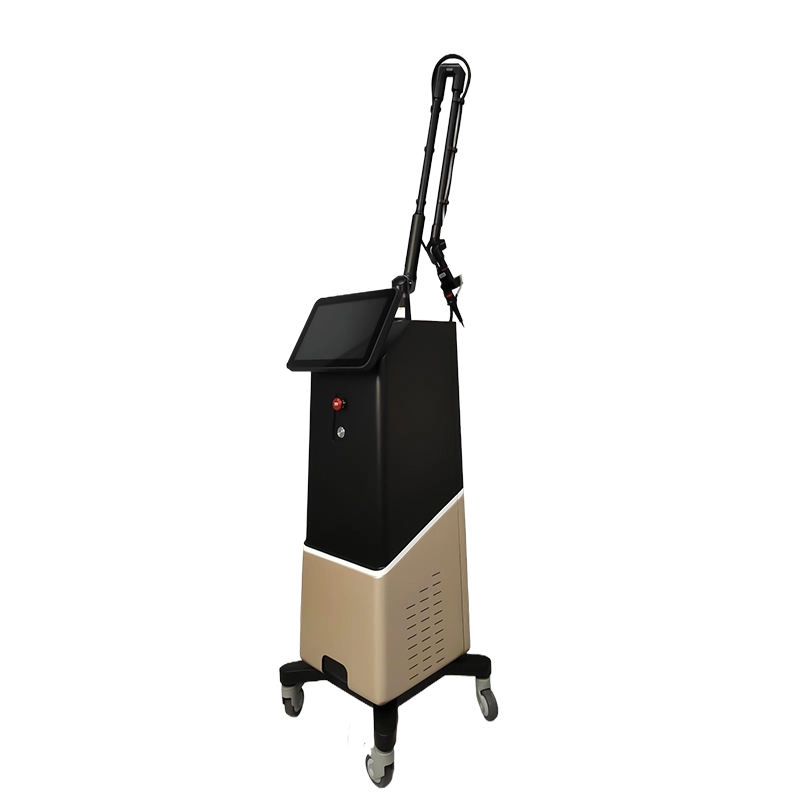
CO2 Fractional Laser Machine for Advanced Skin Resurfacing & Scar Removal
The CO2 fractional laser machine is designed to address a variety of skin concerns, offering treatments for acne scars, pigmentation, wrinkles, and overall skin texture. Utilizing advanced CO2 fractional laser technology, it delivers highly precise and controlled laser energy to promote collagen production and skin rejuvenation. This machine is ideal for professional use in beauty salons, medical spas, and aesthetic clinics. It features a user-friendly touchscreen interface, adjustable settings for customizable treatments, and a built-in cooling system to ensure comfort during use.

V9 Slimming Machine | 5-in-1 Professional Body Contouring & Cellulite Reduction Device | Vacuum, RF, Cavitation, Infrared & Roller
The V9 Slimming Machine is a comprehensive, professional-grade aesthetic device designed to address a wide range of body and facial concerns. This all-in-one system masterfully integrates five powerful technologies—vacuum, roller, infrared, RF, and cavitation—to deliver a complete solution for slimming and shaping.
It is the ideal choice for businesses looking to offer a multi-functional device that can perform multiple treatments, from reducing fat and cellulite to lifting and tightening the skin. The V9 Slimming Machine helps clients combat issues like postpartum obesity, local obesity, and facial sagging.

9 in 1 Gel Radio Frequency Machine – Cavitation Vacuum Machine 40K 80K with RF Skin Tightening Body Shape Weight Loss Fat Cavitation System
The 9 in 1 Gel Radio Frequency Machine is a professional multifunctional body shaping and skin management system designed for beauty salons and slimming centers. Utilizing 40K and 80K cavitation, this device effectively breaks down stubborn fat cells, promoting rapid body contouring and weight loss.
Equipped with advanced RF Skin Tightening technology, the machine stimulates collagen regeneration, tightens sagging skin, reduces wrinkles, and enhances elasticity. The integrated Body Shape Weight Loss Fat Cavitation system delivers powerful shaping results for the abdomen, arms, legs, and waist.
With nine specialized handles, the machine supports multiple facial and body treatments including cavitation slimming, RF tightening, vacuum shaping, and photon rejuvenation—providing a complete 9-in-1 solution for both fat reduction and skin improvement.
Perfect for professional salons seeking to upgrade their services with a versatile and high-performance 9 in 1 cavitation and radio frequency machine.
Get more information
If you have any comments or good suggestions, please leave us a message; later our professional staff will contact you as soon as possible.
Let's Talk
Stay in touch with us for cutting-edge beauty solutions, professional guidance, and customized service.
Contact


Room 307, Building A, Huilong International E-commerce Industrial Park, No. 10 Xipengling Road, Helong Street, Baiyun District, Guangzhou, China
© 2025 HUIMAIN. All Rights Reserved. Privacy Policy | Terms and Conditions | Sitemap
Facebook
Instagram
Medical beauty equipment factory
huimain Medical beauty equipment factory
beauty machine supplier
Whatsapp: +8619124004543