


ODM vs OEM: Choosing a Skin Analyzer Machine Partner
- Selecting a Clinical-Grade Complexion Diagnostics Partner
- Procurement objectives and buyer outcomes
- Key technical specifications to demand
- Regulatory and clinical validation checkpoints
- ODM vs OEM: Comparative Procurement and Risk Profiles
- Ownership, intellectual property and design control
- Cost structure, MOQs and unit economics
- Time-to-market, scalability and supply chain resilience
- Technical & Operational Checklist for Integrating an Imaging Analyzer
- Hardware modules and imagery pipeline
- Algorithmic validation, software lifecycle and updates
- Data security, interoperability and privacy
- Why Choose a High-Tech Manufacturer as a Strategic Partner
- Supplier evaluation: quality systems and certifications
- After-sales, warranty and global support networks
- Case for selecting HUIMAIN as a manufacturing partner
- Frequently Asked Questions
Market leaders and purchasing teams seeking a high-accuracy complexion diagnostic system must balance design control, regulatory responsibility, and total cost of ownership when selecting between private-label manufacturing and full product development partnerships. This guide presents a structured procurement framework for clinical-grade dermal imaging platforms (sometimes referenced as a professional skin analyzer machine), compares the operational and compliance trade-offs of OEM vs ODM engagements, supplies a technical integration checklist, and outlines how to evaluate a high-tech contract manufacturer for long-term program success.
Selecting a Clinical-Grade Complexion Diagnostics Partner
Procurement objectives and buyer outcomes
Buyers should define primary commercial goals before engaging suppliers: rapid market entry with existing hardware, bespoke capabilities for brand differentiation, or a regulatory-ready medical device for clinical settings. Project owners must rank priorities — time-to-market, intellectual property retention, unit economics, or bespoke user experience — because each priority steers the project toward either contract-assembly relationships or full design-and-build partnerships.
Key technical specifications to demand
Technical requirements must be stated as measurable acceptance criteria: imaging resolution (MP and sensor type), multispectral illumination (UV/visible/IR bands), polarization control, algorithmic classification accuracy (sensitivity/specificity targets), calibration drift tolerance, and environmental operating ranges. Request objective test protocols and raw data export formats (DICOM/CSV images) to validate claims during vendor evaluation.
Regulatory and clinical validation checkpoints
Regulatory requirements are decisive for procurement strategy. Medical-class diagnostic systems commonly require documented quality systems and clinical evidence. Suppliers should provide Quality Management System documentation aligned with ISO 13485. For devices intended for EU markets, CE marking and compliance guidance is available via the EU CE Marking guidance. For the U.S., classification and regulatory pathways are governed by the FDA - Medical Devices. These references should form the baseline of any compliance due diligence.
ODM vs OEM: Comparative Procurement and Risk Profiles
Ownership, intellectual property and design control
In a private-label manufacturing agreement, the buyer typically supplies or selects finalized designs; the manufacturer implements production processes. An original design manufacturer takes ownership of engineering and often retains component-level design IP unless negotiated otherwise. Project owners must contractually define IP assignment, source-code escrow, and design-for-manufacturability (DFM) responsibilities to prevent surprises at scale.
Cost structure, MOQs and unit economics
Cost comparison depends on development amortization, BOM choices, and production volume. OEM arrangements reduce upfront engineering fees but can increase per-unit cost when design changes are required. ODM projects have higher initial NRE (non-recurring engineering) but allow customization that can lower long-term per-unit costs at high volumes. Buyers should request a Total Cost of Ownership (TCO) model covering NRE, per-unit costs at tiered quantities, logistics, and service parts provisioning.
Time-to-market, scalability and supply chain resilience
Time-to-market differs: reusing an established platform accelerates launch, while full development programs require prototype iteration and clinical testing. Evaluate suppliers’ component sourcing strategies, dual-sourcing plans, and pandemic-era resilience measures. Ask for documented lead-time performance, supplier scorecards, and capacity forecasts to align procurement milestones with marketing campaigns.
| Comparison Dimension | OEM (Private Label) | ODM (Full Design) |
|---|---|---|
| Design ownership | Buyer owns final product design; manufacturer follows specs | Manufacturer leads design; IP ownership negotiable |
| Customization | Limited to cosmetic/firmware adjustments | High—hardware, firmware, and UI can be tailored |
| Typical development lead time | 4–12 weeks for existing designs; depends on SKU selection | 3–9 months from concept to production-ready prototype |
| Minimum order quantity (MOQ) | Often lower for standard SKUs (e.g., 50–500 units) | Higher initial MOQ may be required to justify NRE (negotiable) |
| Regulatory responsibility | Buyer usually responsible for final regulatory submission | Manufacturer may support clinical testing and documentation |
| Best for | Brand owners needing fast replenishment and low engineering risk | Companies seeking product differentiation and integrated R&D |
Technical & Operational Checklist for Integrating an Imaging Analyzer
Hardware modules and imagery pipeline
Confirm sensor specifications, optics, illumination sources, and mechanical tolerances. Validate the complete imaging pipeline: raw capture, demosaicing, color correction, and standardized calibration routine. Insist on factory calibration certificates and an accessible calibration protocol to maintain consistency across production batches.
Algorithmic validation, software lifecycle and updates
Algorithm performance must be reproducible. Require documented dataset provenance, annotation standards, and cross-validation metrics. Review change-control procedures for software updates; ensure remote update mechanisms are secure and that versioning supports rollback. For medical claims, software as a medical device (SaMD) guidance should be followed.
Data security, interoperability and privacy
Designers must implement encrypted storage and transit, role-based access control, and anonymization where necessary to comply with GDPR/HIPAA-like frameworks. Ensure API documentation for EMR integration and standard export formats (e.g., PNG/TIFF, CSV, HL7 if applicable) to enable seamless workflow integration with clinic management systems.
Why Choose a High-Tech Manufacturer as a Strategic Partner
Supplier evaluation: quality systems and certifications
A reliable supplier should demonstrate a mature quality system, traceable manufacturing records, and certifications appropriate to intended markets. Reference third-party standards such as ISO 13485 and EU CE marking. For medical device market entry in the United States, consult the FDA for classification and submission pathways. Independent testing reports (SGS/Intertek) and patent filings strengthen supplier credibility.
After-sales, warranty and global support networks
Procurement contracts must state warranty terms, spare-parts availability, and SLAs for field repair. Verify the supplier’s global support model: regional warehouses, technical training, remote diagnostics, and replacement part lead-times. These factors materially affect uptime and total lifecycle costs for clinic operators and distributors.
Case for selecting HUIMAIN as a manufacturing partner
Our engineering and production model aligns with the needs described above. Guangzhou Huimain Technology Co., Ltd. is a high-tech enterprise specializing in the research, development, production, and after-sales service of clinical and consumer beauty equipment. Operating from a 3,000-square-meter facility, our technical team has a high percentage of advanced-degree professionals. Dedicated purchasing, clinical testing, and engineering departments ensure continual R&D investment and fast iteration cycles for new diagnostic products.
We hold CE certification, have obtained SGS approval, and maintain numerous patents that underpin our product roadmaps. Our OEM and ODM capabilities are structured to support salon chains, med-aesthetic clinics, and international distributors with scalable manufacturing, regulatory documentation support, and competitive pricing. HUIMAIN’s product range spans Cryolipolysis systems, EMS sculpting devices, Plasma and Shockwave platforms, HIFU solutions, Hydrofacial stations, Cavitation vacuum systems, laser hair removal and tattoo removal units, and microneedling devices — enabling cross-selling opportunities and single-vendor procurement for multi-therapy portfolios.
Buyers requiring bespoke diagnostic imaging modules benefit from our integrated R&D approach: clinical testing protocols are developed in-house, firmware and image-processing pipelines are version-controlled, and supply chain transparency is provided for component traceability. For partners targeting regulated medical markets, our teams assist in compiling technical files, performance testing, and conformity dossiers to streamline CE or FDA pathways.
Contact and product discovery are available via our corporate site to review technical whitepapers, compliance documentation, and sample configurations.
For independent context on device classification and regulatory frameworks, consult Wikipedia - Medical device and the FDA guidance linked earlier.
At the operational level, HUIMAIN provides configurable BOMs, prototype cycles with documented test reports, MOQ and pricing tiers aligned with launch forecasts, and after-sales service programs including training and spare-part kits to reduce clinic downtime.
If procurement teams require a turnkey partner capable of producing both salon-grade and clinical-class imaging and therapy devices, HUIMAIN’s ODM and OEM pathways deliver the technical depth and compliance support necessary to mitigate commercialization risk and optimize long-term return on investment.
Explore product specifications or request a partnership consultation through our website or by emailing coco@huimainbeauty.com.
Frequently Asked Questions
What is the main difference between OEM and ODM for skin analysis devices?
OEM (original equipment manufacturing) typically means the buyer provides the final design or chooses an existing product for private labeling, while ODM (original design manufacturing) involves the supplier leading product design and development; IP ownership and engineering responsibilities differ and must be contractually defined.
Who is responsible for regulatory submissions when buying a diagnostic imaging system?
Regulatory responsibility depends on contract terms; buyers often handle final submissions for private-label products, but an ODM partner can provide technical documentation, clinical test reports, and conformity files to support CE marking or FDA pathways.
What lead times and MOQs should procurement teams plan for?
Lead times vary: selecting an existing platform can reduce time-to-market to weeks, whereas full-design projects commonly take several months from concept to production-ready units. MOQ depends on BOM and tooling costs; buyers should request tiered pricing and MOQ options from suppliers during RFP evaluation.
Which technical specs matter most when evaluating a dermal imaging partner?
Prioritize sensor resolution and type, multispectral illumination (UV/visible/IR), polarization control, repeatable factory calibration, algorithm validation metrics (sensitivity/specificity), data export formats, and API interoperability for clinic workflows.
How can HUIMAIN support after-sales, training and spare parts?
HUIMAIN provides structured after-sales programs including regional spare-part kits, technician training, remote diagnostics, and SLA-backed repair services; these offerings are designed to reduce downtime and support global distributors and clinic operators.

CO2 Fractional Laser Machine – Professional Wrinkle Removal & Skin Resurfacing Device
The CO2 Fractional Laser Machine is a multifunctional aesthetic device designed for professional clinics and beauty salons. Using advanced fractional CO2 laser technology, it effectively targets acne scars, freckles, pigmentation, nevi, and deep wrinkles. Additionally, it provides non-invasive skin rejuvenation, vaginal tightening, and intimate beautification. This professional CO2 laser equipment combines precision, safety, and powerful energy output to deliver outstanding anti-aging and dermatological results.

Gold RF Microneedle Machine | Professional Fractional RF System for Face & Body Scar Repair
The Gold RF Microneedle Machine is a cutting-edge aesthetic device designed for B2B professionals, offering a powerful, dual-action solution for both facial beauty and body scar repair. This system combines the precision of microneedling with the proven effectiveness of radio frequency (RF) energy to treat a wide range of skin concerns.
By delivering high-frequency heat through insulated gold-plated microneedles, it stimulates the skin's natural healing process, leading to collagen regeneration and the production of new elastin. This innovative approach provides a minimally invasive solution for treating fine lines, wrinkles, acne scars, stretch marks, and skin laxity with minimal downtime.

Pelvic Floor Chair | Emslim Pelvic Machine for Strengthening and Sculpting
The **Pelvic Floor Chair** is an innovative device designed for strengthening and toning pelvic muscles using advanced **EMS technology**. This ergonomic chair provides a comfortable and effective solution for individuals seeking to enhance pelvic floor health, improve muscle tone, and support postpartum recovery. Equipped with a user-friendly touchscreen interface, it allows easy control of intensity and frequency for tailored treatments. Suitable for both home and professional use, this **Emslim chair** ensures reliable and non-invasive results.
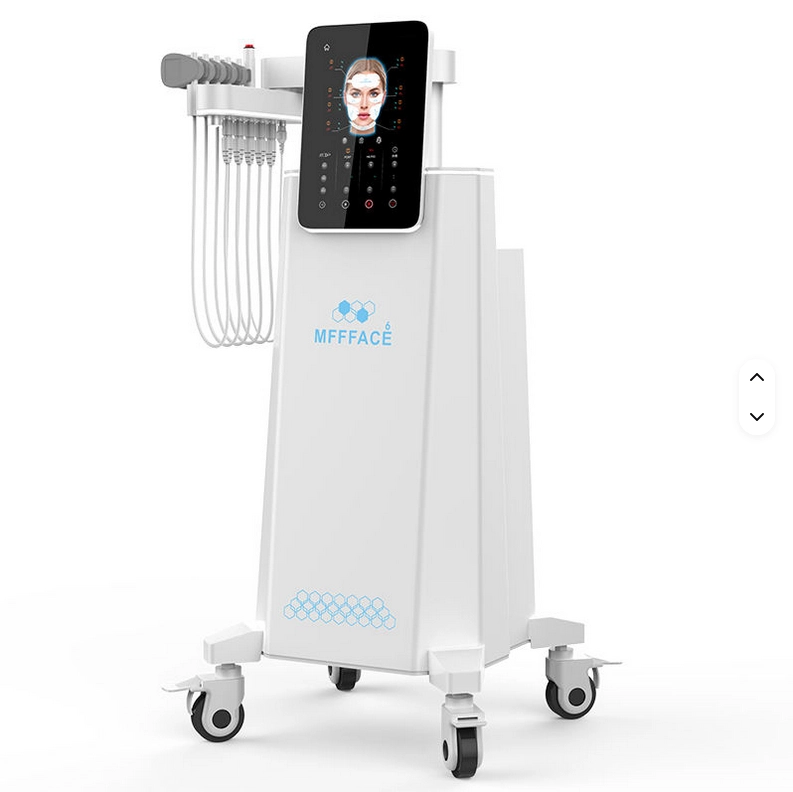
MFFFace 6 EMS+RF Facial Muscle Training Machine – Professional Magnetic Face Lifting & Skin Tightening Device
The MFFFace 6 EMS+RF Facial Muscle Training Machine is a cutting-edge beauty device designed for professional facial lifting, firming, and rejuvenation.
Combining EMS microcurrent technology with radio frequency (RF) thermal energy, it stimulates facial muscles and promotes collagen regeneration, resulting in tighter, smoother, and more youthful-looking skin.
With 6 independent magnetic handles, MFFFace 6 allows multiple treatment areas to be targeted simultaneously — maximizing efficiency for beauty salons and clinics.
This non-invasive and painless treatment helps sculpt facial contours, reduce sagging, and restore elasticity with visible improvements in just a few sessions.
Perfect for aesthetic professionals who want to offer advanced anti-aging treatments and achieve instant lifting results.
Get more information
If you have any comments or good suggestions, please leave us a message; later our professional staff will contact you as soon as possible.
Let's Talk
Stay in touch with us for cutting-edge beauty solutions, professional guidance, and customized service.
Contact


Room 307, Building A, Huilong International E-commerce Industrial Park, No. 10 Xipengling Road, Helong Street, Baiyun District, Guangzhou, China
© 2026 HUIMAIN. All Rights Reserved. Designed by Gooeyun. Privacy Policy | Terms and Conditions | Sitemap
Facebook
Instagram
Medical beauty equipment factory
huimain Medical beauty equipment factory
beauty machine supplier
Whatsapp: +8619124004543