


Ultimate Hair Removal Machine Comparison: IPL vs. Diode vs. Alexandrite (2026 Edition)
- What Is a Hair Removal Machine?
- Key Takeaways: 2026 Market Summary
- Intense Pulsed Light (IPL) Machines: Pros and Cons
- Diode Lasers: The Versatile Gold Standard
- Alexandrite Lasers: Speed and Precision
- The Nd:YAG Factor: Safety for Darker Skin
- Expert Tips: Common Mistakes When Choosing a Machine
- 2026 Pricing, Maintenance, and ROI Breakdown
- Conclusion
- Which is better: IPL or diode laser?
- Is Alexandrite laser safe for dark skin?
- How long do laser hair removal machines last?
- Do hair removal machines actually work permanently?
- What wavelength is best for hair removal?
- Does laser hair removal technology hurt?
- Can I use professional laser machines at home?
- How much does a commercial hair removal machine cost?
Investing in professional laser hair removal equipment is one of the most critical decisions for any modern aesthetic clinic or ambitious home user. As technology rapidly evolves, navigating the cosmetic market can feel overwhelming. This comprehensive guide provides an in-depth look at the top modalities available today. We will explore everything from wavelength specifics to pricing and return on investment (ROI), ensuring you make an educated decision for your business in this rapidly growing industry.
What Is a Hair Removal Machine?
A hair removal machine is a specialized cosmetic device that uses focused light energy (lasers) or broad-spectrum light (IPL) to target and destroy melanin in hair follicles. This process permanently reduces hair growth by disabling the follicle's reproductive cycle.
To understand how these machines work, we must look at the science of hair growth. By utilizing the principle of selective photothermolysis, these machines prevent future hair growth, resulting in long-term or permanent hair reduction for users, as reported by Wikipedia. The energy is absorbed by the melanin (pigment) in the hair shaft, which converts to heat and travels down to the dermal papilla—the root of the hair. Once the root is thermally damaged during its active anagen growth phase, it loses its ability to produce new hair.
Key features of a high-quality machine include:
- Energy Delivery: Uses highly concentrated laser beams or intense pulsed light to penetrate the skin.
- Targeted Chromophores: Specifically targets melanin without damaging surrounding epidermal tissue.
- Cooling Mechanisms: Incorporates advanced sapphire or cryogen cooling tips to protect the outer skin layer and maximize patient comfort.
Key Takeaways: 2026 Market Summary
The 2026 market summary reveals that modern devices increasingly feature AI-driven skin sensors and advanced ice-cooling tech for virtually painless sessions. Choosing the right device depends on balancing upfront costs, skin tone compatibility, and the desired speed of treatments.
When looking for the best hair removal machine 2026 has to offer, clinic owners and consumers must consider how technological advancements have bridged the gap between efficacy and comfort. The newest generation of devices removes the guesswork from treatments by automatically adjusting parameters based on real-time skin melanin readings.
The primary market takeaways include:
- IPL: Best suited for affordable, at-home maintenance but requires high contrast between skin and hair color.
- Diode: Offers the best balance of safety, comfort, and efficacy across the widest range of skin types.
- Alexandrite: Provides the fastest treatment times for lighter skin tones, optimizing clinic turnover rates.
- Nd:YAG: Remains the absolute gold standard for safely treating darker complexions without causing hyperpigmentation.
Intense Pulsed Light (IPL) Machines: Pros and Cons
Intense Pulsed Light (IPL) uses broad-spectrum light with multiple wavelengths, making it less targeted than true lasers. These devices are highly popular for at-home use due to their lower energy output and user-friendly, budget-conscious designs.
When conducting an IPL vs diode laser comparison, it is crucial to understand that IPL is technically not a laser. Instead of emitting a single, focused wavelength, IPL uses flashlamps to emit a broad spectrum of light (usually between 500 nm and 1200 nm). Filters are then used to block out unwanted wavelengths. While this makes IPL versatile, it dilutes the power delivered directly to the hair follicle.
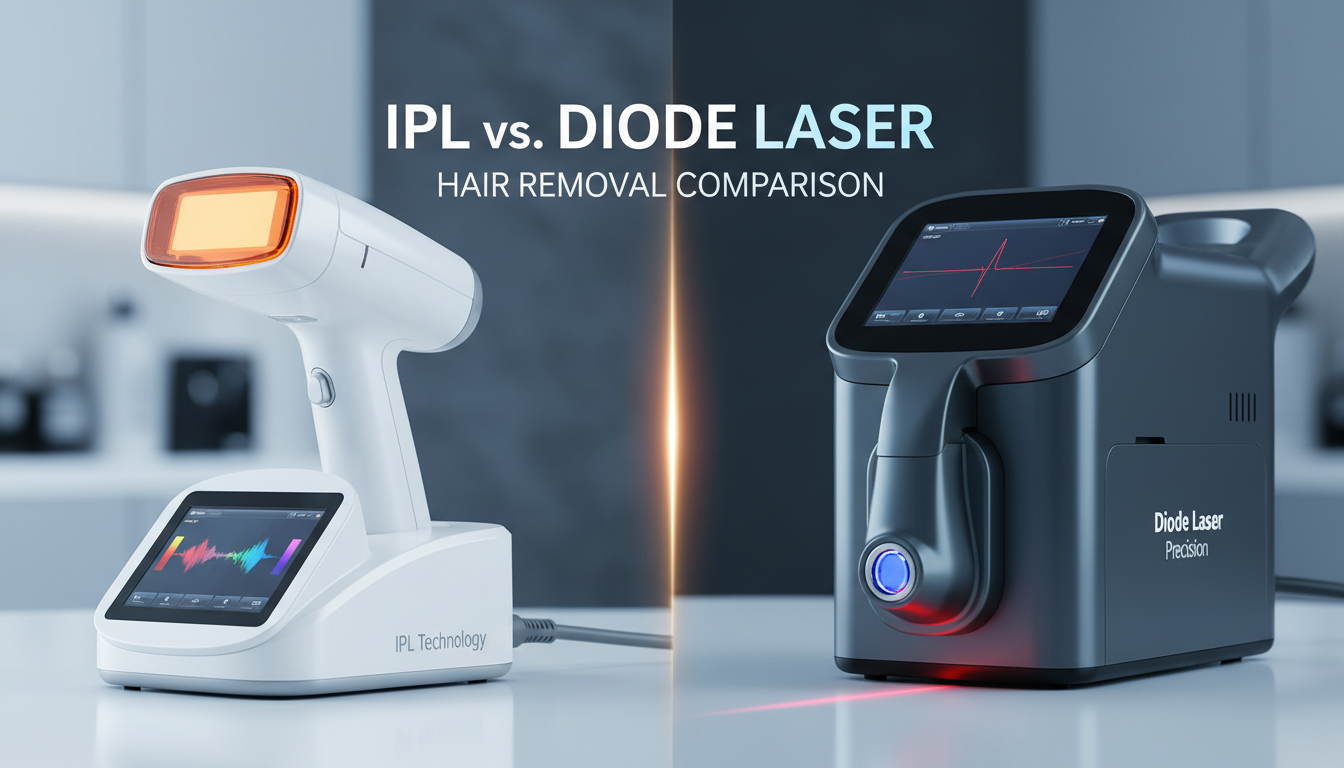
The pros and cons of IPL technology include:
- Limitations: IPL carries a higher risk of burns on darker skin tones because the broad light is easily absorbed by epidermal melanin. It generally requires more sessions to achieve desired results.
- Versatility: Can be used for other skin treatments, such as addressing superficial pigmentation and vascular lesions.
- Best for: Educated home users and clinics offering entry-level, budget-friendly treatments where absolute clinical power is not the primary focus.
Diode Lasers: The Versatile Gold Standard
Operating typically at an 800-810 nm wavelength, Diode lasers offer deep penetration into the hair follicle. They are considered the versatile gold standard because they provide a strong safety profile for a wide spectrum of skin tones.
The specific wavelength of the Diode laser allows it to bypass the epidermis more effectively than Alexandrite, delivering heat deeper into the dermis where the hair follicle resides. They are highly effective for coarse hair and provide a strong safety profile for Fitzpatrick skin types I through V, a numerical classification schema for human skin color developed in 1975, as noted by Wikipedia.
The standout features of Diode technology include:
- Advanced Delivery Methods: Modern 2026 Diode machines feature high repetition rates, allowing for "in-motion" or gliding techniques rather than traditional stationary stamping. This significantly reduces missed spots.
- Patient Comfort: Superior contact cooling mitigates the heat delivered to the skin, making the procedure virtually painless.
- Best for: Clinics looking for a versatile, reliable workhorse that can safely treat the vast majority of their clientele.
Alexandrite Lasers: Speed and Precision
Running at a 755 nm wavelength, the Alexandrite laser is highly absorptive to melanin, delivering unmatched speed and precision. This makes it exceptionally effective for individuals with light skin and dark hair, allowing practitioners to treat large areas rapidly.
Alexandrite laser technology is incredibly powerful for treating fine, light-colored hairs that deeper penetrating lasers often leave behind. Because the 755 nm wavelength is so aggressively absorbed by melanin, the thermal destruction of the follicle is swift and absolute. However, this same melanin absorption means it is strictly limited to lighter skin tones to avoid epidermal damage.
The benefits and applications of Alexandrite include:
- Rapid Treatment Times: Known for exceptionally large spot sizes and rapid repetition rates, it allows practitioners to treat expansive areas like backs and legs quickly.
- High Efficacy: Achieves rapid clearance of hair in fewer sessions for ideal candidates.
- Best for: High-volume clinics primarily serving fair-skinned demographics (Fitzpatrick types I-III).
The Nd:YAG Factor: Safety for Darker Skin
The Nd:YAG laser operates at a 1064 nm wavelength, safely bypassing epidermal melanin to deliver heat directly to the dermal blood supply of the follicle. This makes it the safest and most effective option for darker skin tones.
Though it may not be the primary focus of every aesthetic menu, the use of Nd:YAG wavelengths for dark skin is an absolute necessity for an inclusive clinic. Because the 1064 nm wavelength has very low melanin absorption, it relies on reaching the microvasculature of the hair follicle to induce thermal damage. This prevents the surface skin from absorbing the heat and suffering burns.
Key advantages of Nd:YAG technology include:
- Epidermal Bypassing: Delivers heat directly to the deep dermal layers, neutralizing the follicle without risking surface burns.
- Ultimate Safety: This makes it the safest and most effective option for Fitzpatrick skin types IV-VI, effectively preventing post-inflammatory hyperpigmentation.
- Best for: Diverse, inclusive clinics and patients with deep, rich skin tones who cannot safely use Alexandrite or IPL.
Expert Tips: Common Mistakes When Choosing a Machine
The most common mistake when selecting a machine is ignoring skin type compatibility and FDA clearances. Practitioners must verify pulse duration, peak power, and the presence of integrated cooling systems to ensure patient safety and optimal clinical results.
Investing in a machine based on price alone often leads to buyer's remorse and poor patient outcomes. The precision of the laser is paramount; lasers can selectively target dark, coarse hairs while leaving the surrounding skin undamaged, as highlighted by WebMD. Without the proper settings, a laser is either ineffective or dangerous.
Avoid these critical industry mistakes:
- Mistake 1: Ignoring skin type compatibility. Always verify the Fitzpatrick scale range the machine is FDA-cleared to treat to avoid liability and patient harm.
- Mistake 2: Overlooking pulse duration and fluence. A machine with weak peak power will deliver sub-lethal heat, resulting in paradoxical hair stimulation instead of hair reduction.
- Mistake 3: Neglecting cooling systems. Practitioner speed and patient retention rely heavily on the comfort provided by integrated sapphire or cryogen cooling.
2026 Pricing, Maintenance, and ROI Breakdown
Competitors often hide costs, but 2026 professional machines range from $15,000 for standard Diodes to over $80,000 for premium dual-wavelength systems. Calculating a clinic's ROI requires factoring in upfront prices, consumable costs like flash lamps, and annual servicing.
A transparent financial overview is essential before purchasing aesthetic technology. While at-home IPL devices currently range from $250 to $600—offering great personal ROI but lacking clinical power—professional devices require a substantial capital investment. However, the profitability of a successful laser hair removal program is exceptionally high.
When breaking down your 2026 clinic ROI, consider the following metrics:
- Initial Capital: Budget between $15,000 to $80,000+ depending on whether you choose a single-wavelength Diode or a premium Alexandrite/Nd:YAG hybrid.
- Consumables: Factor in the cost of flash lamps, protective eyewear, ultrasound gel, cryogen canisters, and mandatory annual servicing contracts.
- Profit Velocity: Top-tier equipment typically pays for itself within 6-8 months in a high-traffic clinic due to faster treatment times and the ability to charge premium pricing for pain-free sessions.
Conclusion
Choosing the right hair removal machine comes down to understanding your target demographic, budget, and exact clinical efficacy requirements. IPL is a fantastic entry point for home use, Diode offers the ultimate clinical versatility across various skin types, and Alexandrite provides unmatched speed for lighter-skinned demographics. To ensure your business thrives, selecting a machine with the correct wavelength, robust peak power, and advanced cooling technology is paramount. By investing wisely, you can deliver safe, permanent results that keep clients coming back.
Contact us today to optimize your professional laser hair removal equipment strategy.
Which is better: IPL or diode laser?
Diode lasers are generally more effective, targeted, and require fewer sessions for permanent reduction. IPL is broader and less powerful, making it better suited for affordable, at-home maintenance rather than clinical results.
Is Alexandrite laser safe for dark skin?
No, Alexandrite targets melanin very aggressively, which can cause burns or hyperpigmentation on darker skin tones. For dark skin (Fitzpatrick IV-VI), an Nd:YAG laser is the safest and most effective choice.
How long do laser hair removal machines last?
Professional laser machines are rated for millions of pulses and can last 5-10 years with proper maintenance. At-home IPL devices typically offer between 300,000 and 500,000 flashes, lasting an individual user around 10 to 15 years.
Do hair removal machines actually work permanently?
They provide permanent hair reduction rather than absolute 100% removal. The FDA classifies them as reducing hair growth significantly, though occasional touch-up sessions may be needed over the years.
What wavelength is best for hair removal?
The best wavelength depends entirely on the user's skin tone. 755 nm (Alexandrite) is best for light skin, 810 nm (Diode) is best for medium skin, and 1064 nm (Nd:YAG) is best for dark skin.
Does laser hair removal technology hurt?
While older models caused significant discomfort, 2026 machines use advanced contact cooling. Most patients describe the sensation as a mild rubber band snap against the skin, making it highly tolerable.
Can I use professional laser machines at home?
It is highly discouraged. Professional machines are Class IV medical devices requiring specialized training and safety protocols. Consumers should stick to FDA-cleared at-home IPL or low-energy Diode devices for personal use.
How much does a commercial hair removal machine cost?
Professional commercial machines range from $10,000 for basic models to over $80,000 for advanced dual-wavelength systems. Factors influencing price include peak power, spot size, cooling mechanisms, and brand reputation.
JHF-51
What is the benefit of privacy detection technology?
Privacy detection improves treatment safety and discretion, especially for intimate and sensitive procedures.
HMT82S-2
How long does each session take, and how often should it be done?
Each session takes around 30 minutes. We recommend 2 sessions per week, with a treatment course of 4–6 sessions, depending on individual goals and body condition.
HMC1S
Q5: Does the Pelvic Floor Chair require any special maintenance?
A5: The chair is low-maintenance. Simply clean the surface regularly and ensure it is stored in a cool, dry place.
About OEM & ODM
Can you customize products according to our requirements?
Yes, we offer OEM and ODM services, including product design, function customization, and packaging.
ETG502
What is the working principle of cryolipolysis?
Cryolipolysis uses the unique sensitivity of fat cells to cold temperatures. Through precisely controlled low temperatures (typically between -10°C and 10°C), the device freezes and crystallizes fat cells. The crystallized fat cells then undergo natural apoptosis and are gradually metabolized and eliminated by the body's lymphatic system, leading to a reduction in localized fat.

CO2 Fractional Laser Machine – Professional Wrinkle Removal & Skin Resurfacing Device
The CO2 Fractional Laser Machine is a multifunctional aesthetic device designed for professional clinics and beauty salons. Using advanced fractional CO2 laser technology, it effectively targets acne scars, freckles, pigmentation, nevi, and deep wrinkles. Additionally, it provides non-invasive skin rejuvenation, vaginal tightening, and intimate beautification. This professional CO2 laser equipment combines precision, safety, and powerful energy output to deliver outstanding anti-aging and dermatological results.

9 in 1 Gel Radio Frequency Machine – Cavitation Vacuum Machine 40K 80K with RF Skin Tightening Body Shape Weight Loss Fat Cavitation System
The 9 in 1 Gel Radio Frequency Machine is a professional multifunctional body shaping and skin management system designed for beauty salons and slimming centers. Utilizing 40K and 80K cavitation, this device effectively breaks down stubborn fat cells, promoting rapid body contouring and weight loss.
Equipped with advanced RF Skin Tightening technology, the machine stimulates collagen regeneration, tightens sagging skin, reduces wrinkles, and enhances elasticity. The integrated Body Shape Weight Loss Fat Cavitation system delivers powerful shaping results for the abdomen, arms, legs, and waist.
With nine specialized handles, the machine supports multiple facial and body treatments including cavitation slimming, RF tightening, vacuum shaping, and photon rejuvenation—providing a complete 9-in-1 solution for both fat reduction and skin improvement.
Perfect for professional salons seeking to upgrade their services with a versatile and high-performance 9 in 1 cavitation and radio frequency machine.

5-in-1 40K Cavitation Vacuum Machine for Body Slimming & Fat Reduction
The 5-in-1 40K Cavitation Vacuum Machine is a professional body shaping system designed for fat reduction, cellulite smoothing, and overall body contouring. Using 40KHz ultrasonic cavitation, this device breaks down stubborn fat cells, while vacuum suction improves lymphatic drainage and accelerates toxin removal.
With multiple RF tightening handles, the machine stimulates collagen regeneration and helps lift and firm loose areas of the body. Compact, powerful, and easy to operate, it is the perfect solution for beauty salons, spa centers, and slimming studios seeking fast and visible fat-reduction results.
This cavitation vacuum machine is built to deliver safe, non-invasive treatments with no downtime—making it a top choice for body contouring professionals.

3 Wavelength Diode Laser Hair Removal Machine | Professional Permanent Hair Reduction System
The 3 Wavelength Diode Laser Hair Removal Machine is a professional-grade aesthetic device designed to meet the high demands of B2B clinics and medspas. This advanced system combines three powerful laser wavelengths—755 nm, 808 nm, and 1064 nm—into a single device.
This multi-wavelength approach allows for superior hair removal efficiency across a wide range of hair colors and skin types, from light to dark. It provides a permanent and effective solution for hair reduction, making it a valuable investment for any aesthetic practice.
Get more information
If you have any comments or good suggestions, please leave us a message; later our professional staff will contact you as soon as possible.
Let's Talk
Stay in touch with us for cutting-edge beauty solutions, professional guidance, and customized service.
Contact


Room 307, Building A, Huilong International E-commerce Industrial Park, No. 10 Xipengling Road, Helong Street, Baiyun District, Guangzhou, China
© 2025 HUIMAIN. All Rights Reserved. Privacy Policy | Terms and Conditions | Sitemap
Facebook
Instagram
Medical beauty equipment factory
huimain Medical beauty equipment factory
beauty machine supplier
Whatsapp: +8619124004543