


- What Buyers Really Mean by “Best Pressotherapy Machine”
- Why a Professional Pressotherapy Machine Is Different From a Basic Unit
- The Most Important Features to Compare Before You Buy
- 1. Pressure control and treatment adjustability
- 2. Garment configuration and body-area coverage
- 3. User interface and staff learning curve
- 4. Treatment flexibility and service expansion potential
- 5. Build quality and repeat-use durability
- Should You Choose a Standalone Pressotherapy Unit or a Multi-Function System?
- How to Evaluate a Pressotherapy Machine for Sale Without Falling Into Price Traps
- What Type of Pressotherapy Machine Fits Different Business Models?
- For beauty salons adding body services
- For spas and wellness centers
- For aesthetic clinics and body contouring studios
- For distributors and importers
- Common Mistakes Buyers Make When Choosing the Best Pressotherapy Machine
- Mistake 1: Focusing on keywords instead of business fit
- Mistake 2: Comparing only the host machine
- Mistake 3: Ignoring staff operation
- Mistake 4: Buying too basic for the target market
- Mistake 5: Not checking supplier capability
- Why Many Buyers Prefer Working With a Professional Manufacturer
- What to Ask Before Requesting a Final Quote
- So, What Is the Best Pressotherapy Machine?
- 9. Conclusion
- 10. FAQ Section
Best Pressotherapy Machine for Sale | Professional Pressotherapy Machine Buying Guide
When buyers search for the best pressotherapy machine, they are rarely looking for the cheapest option. They are trying to find a machine that delivers stable performance, fits their treatment menu, supports repeatable results, and makes commercial sense over time. For spas, salons, and aesthetic clinics, the right choice is not simply about pressure boots and an attractive screen. It is about treatment flexibility, garment design, service positioning, ease of use, and supplier support. If you are comparing a professional pressotherapy machine or reviewing a pressotherapy machine for sale for your business, this guide will help you focus on the factors that matter most before you make a purchasing decision.
What Buyers Really Mean by “Best Pressotherapy Machine”
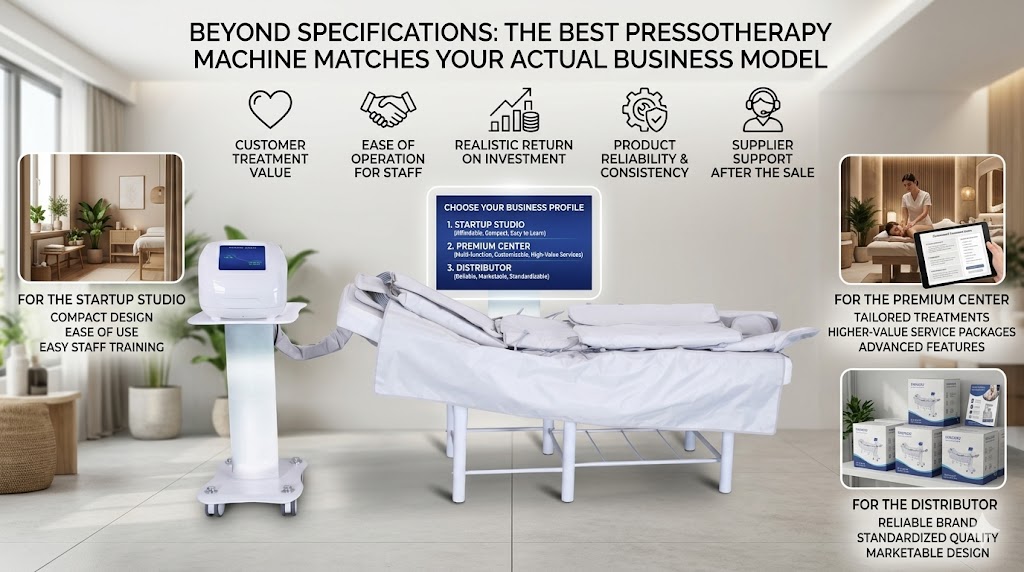
The phrase best pressotherapy machine sounds simple, but in practice it means different things to different buyers. A startup beauty studio may define “best” as affordable, compact, and easy to learn. A premium body contouring center may define it as multi-function, treatment-customizable, and capable of supporting higher-value service packages. A distributor may define it as reliable, visually marketable, and easy to standardize across multiple customers.
That is why the best machine is not always the one with the most functions on paper. It is the one that matches your actual business model.
For commercial buyers, the right question is not “Which pressotherapy machine is the most advanced?” It is “Which machine will help me deliver practical, repeatable treatments and support profitable services?”
A good buying decision usually balances five things:
- treatment value for the end customer
- ease of operation for staff
- realistic return on investment
- product reliability and consistency
- supplier support after the sale
If a machine looks attractive online but creates staff confusion, inconsistent service quality, or frequent maintenance issues, it is not the best machine for a real business.
Why a Professional Pressotherapy Machine Is Different From a Basic Unit
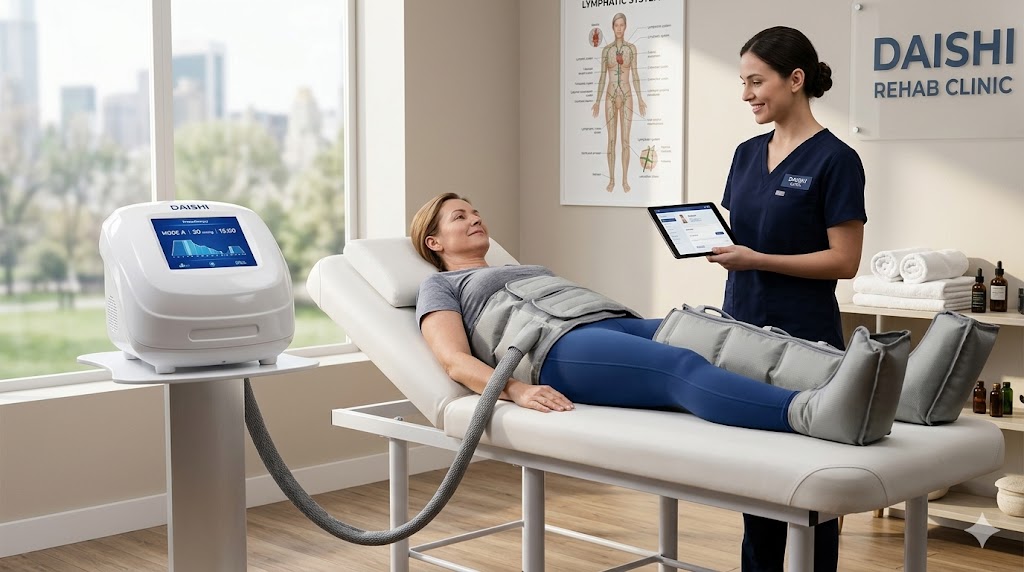
A professional pressotherapy machine should do more than inflate garments. It should give the operator enough control to adapt treatments to different body areas, treatment goals, and customer comfort levels.
Many low-end units focus on selling points that sound good in a listing but do not help much in daily operation. They may be marketed heavily as a pressotherapy machine for sale, yet offer limited programming options, weak garment quality, or poor pressure consistency. That becomes a problem once the machine is used repeatedly in a salon or clinic environment.
Professional buyers should expect a machine to support:
- adjustable treatment settings
- stable and predictable pressure output
- practical garment coverage for the target body areas
- a user-friendly operating system
- enough flexibility for different service combinations
- materials and accessories suitable for repeated use
In other words, commercial-grade equipment should help the operator control the treatment, not guess their way through it.
The Most Important Features to Compare Before You Buy
1. Pressure control and treatment adjustability
This is one of the first areas to evaluate. A machine may claim to be professional, but if it offers limited control, the treatment experience may feel generic instead of tailored.
Look for features such as adjustable intensity, timing, treatment duration, and operation modes. These are important because customer comfort levels vary. Some clients prefer a lighter rhythmic compression experience, while others may want a stronger body-care session, depending on the service positioning and local market expectations.
More adjustable systems are usually better for commercial use because they help your team personalize sessions rather than deliver the same setting to everyone.
2. Garment configuration and body-area coverage
A machine is only as useful as its practical treatment coverage. Some buyers focus only on the console and forget to study the accessories. But garments matter a great deal.
Ask whether the machine supports arms, waist, legs, and feet in a way that fits your intended service menu. If your business plans to promote lower-body recovery sessions, body contouring support services, or full-body wellness packages, accessory coverage becomes a major value point.
A more complete garment set can make it easier to build premium packages rather than selling pressotherapy as a low-priced add-on.
3. User interface and staff learning curve
A machine with too many functions but poor usability can slow down operations. Busy salons and clinics need equipment that staff can learn quickly and use consistently.
A touchscreen interface, clear controls, and intuitive parameter settings all make a difference. They reduce training time, minimize operator error, and make it easier to standardize treatments across multiple staff members.
For growing businesses, easy operation is not a minor convenience. It is part of scalability.
4. Treatment flexibility and service expansion potential
One of the most commercially important questions is whether the machine helps you offer only one service or supports multiple service concepts.
Some businesses want a dedicated pressotherapy-only device. Others want a broader platform that can support more than one body-care modality. In many cases, a multi-function machine can create stronger package design opportunities because it helps you build layered services instead of relying on a single treatment concept.
For example, some professional configurations combine pressure therapy with other body-care functions, giving operators more ways to position services for body contouring support, relaxation, and post-session comfort.
5. Build quality and repeat-use durability
A machine that looks impressive in product photos may not hold up well under daily commercial use. This is especially important for spas, body studios, and clinics running multiple sessions per day.
Durability questions should include:
- Are the garments made for repeated treatment cycles?
- Are connectors, hoses, and attachments easy to manage?
- Does the system appear designed for stable ongoing operation?
- Is the interface responsive and practical for daily use?
- Are replacement accessories available?
Machines intended for professional markets should be evaluated like business tools, not like consumer gadgets.
Should You Choose a Standalone Pressotherapy Unit or a Multi-Function System?
This is one of the most important buying decisions, and the answer depends on your positioning.
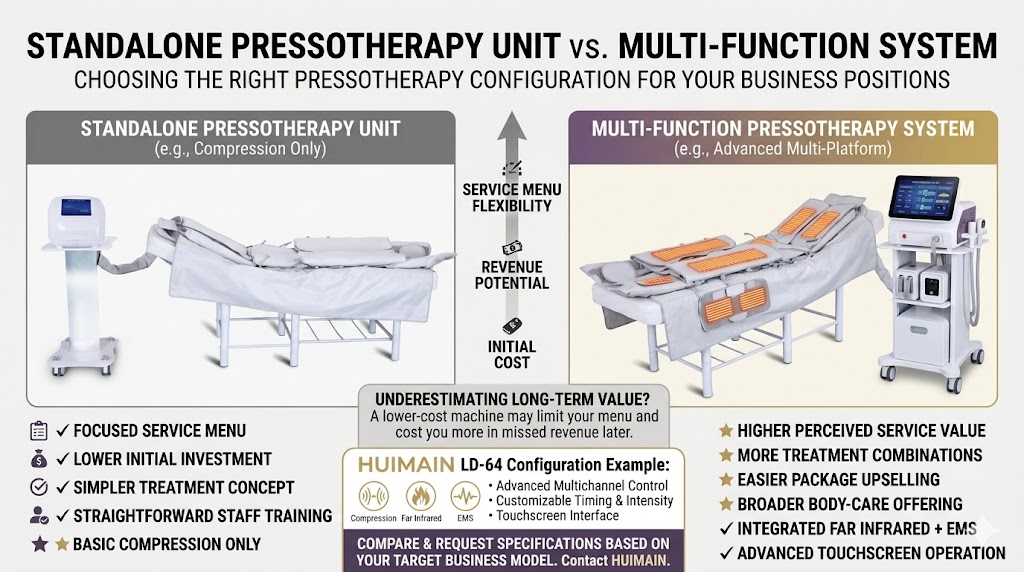
A standalone pressotherapy unit can work well if you want:
- a focused service menu
- a lower initial investment
- a simpler treatment concept
- straightforward staff training
But a multi-function system may be the better choice if you want:
- higher perceived service value
- more treatment combinations
- easier package upselling
- a broader body-care offering from one device footprint
This is where many buyers underestimate long-term value. A lower-cost machine may seem attractive at first, but if it limits your treatment menu, reduces package creativity, or feels too basic for your market segment, it may cost you more in missed revenue later.
HUIMAIN’s pressotherapy-related platform configuration is a useful example of this business logic. A model such as the LD-64 combines pressure therapy with far infrared and EMS-style functionality, alongside programmable settings, adjustable timing, channel control, and touchscreen operation, which makes it more flexible than a very basic compression-only unit. Product-specific details should still be matched to the intended treatment menu and market positioning.
How to Evaluate a Pressotherapy Machine for Sale Without Falling Into Price Traps
A lot of buyers start by searching pressotherapy machine for sale, then comparing listings mostly by appearance and price. That is understandable, but it is also where many poor decisions begin.
A lower quote does not automatically mean lower total cost. In commercial equipment buying, the real cost includes:
- machine lifespan
- treatment consistency
- accessory quality
- training efficiency
- downtime risk
- customer satisfaction
- ability to support premium service pricing
A machine that is slightly more expensive but easier to operate, more durable, and more commercially flexible may offer far better long-term value.
Instead of asking only “What is the price?” ask:
- What functions are included in the standard configuration?
- What accessories come with the machine?
- How flexible are the treatment settings?
- Is the machine intended for frequent salon or clinic use?
- What support is available after purchase?
- Can the supplier support private label, branding, or market adaptation if needed?
This shifts the conversation from cheap purchasing to smart purchasing.
What Type of Pressotherapy Machine Fits Different Business Models?
For beauty salons adding body services
A salon usually benefits from a machine that is easy to learn, visually appealing, and suitable for add-on body-care services. The ideal choice is often a practical professional machine with enough flexibility to support package sales, but without making daily operation too complex.
For spas and wellness centers
Spas usually care more about experience, comfort, and service layering. A machine with adjustable settings and broader body coverage is often more attractive because it supports relaxation-focused and body-care package positioning.
For aesthetic clinics and body contouring studios
Clinics and specialized studios often need a machine that feels more professional, supports customized sessions, and integrates well into broader body treatment programs. In this case, a higher-grade professional pressotherapy machine may be more suitable than a basic entry-level unit.
For distributors and importers
Distributors should think beyond a single sale. They need a product with stable presentation, repeatable quality, and enough market appeal to sell across different customer types. A machine that is too limited may be hard to position. A machine that is too complicated may create training resistance. The best distribution product often sits in the middle: commercially attractive, easy to explain, and operationally practical.
[CTA] If you are selecting models for resale, branding, or local distribution, ask HUIMAIN for a product catalog and configuration comparison so you can match the machine to your market segment more accurately.
Common Mistakes Buyers Make When Choosing the Best Pressotherapy Machine
Mistake 1: Focusing on keywords instead of business fit
Some buyers search for the best pressotherapy machine and assume there must be one universal winner. In reality, the right choice depends on business type, treatment positioning, and price strategy.
Mistake 2: Comparing only the host machine
The garments, connectors, accessories, and treatment setup matter just as much as the console. A weak accessory system can reduce the practical value of the whole purchase.
Mistake 3: Ignoring staff operation
Even a well-configured machine can underperform if the interface is difficult to use or if operators cannot quickly adjust treatments in real working conditions.
Mistake 4: Buying too basic for the target market
If your customers expect premium body-care services, a very simple unit may make your treatment offering feel low-end. This can limit repeat bookings and package pricing.
Mistake 5: Not checking supplier capability
A strong product still needs a dependable supplier behind it. Buyers should review whether the manufacturer understands commercial beauty equipment, supports stable production, and can communicate clearly during and after the order process.
Why Many Buyers Prefer Working With a Professional Manufacturer
When choosing a beauty machine, supplier quality can matter almost as much as product quality. Buyers often prefer experienced manufacturers because they want more than a shipment. They want product consistency, technical clarity, and smoother communication.
A professional manufacturer can often help with:
- model selection based on business needs
- clearer technical explanations
- configuration recommendations
- branding or OEM/ODM support when needed
- packaging and market adaptation
- after-sales coordination
This is one reason HUIMAIN can be integrated naturally into this topic. HUIMAIN is not simply selling a machine listing. It is positioned as a beauty machine manufacturer and OEM/ODM partner that can support buyers who want a more practical commercial discussion rather than a generic marketplace transaction.
That matters especially when the buyer is not just purchasing for one room, but building a treatment menu, opening a new center, or preparing for wholesale or distributor sales.
What to Ask Before Requesting a Final Quote
Before you move from comparison to quotation, prepare a clear checklist. This saves time and leads to more useful supplier responses.
Ask yourself:
- Who is the machine for: salon, spa, clinic, or distribution?
- Do I want a dedicated pressotherapy unit or a multi-function platform?
- Which body areas do I need to cover?
- Is my market more budget-driven or premium-driven?
- Will I need branding, OEM, or label customization later?
- Do I need a simple machine for fast staff adoption or a more feature-rich one for service expansion?
Then ask the supplier:
- What is included in the standard package?
- What treatment functions are built in?
- What optional accessories are available?
- What voltage options are supported?
- What training or technical guidance is available?
- What is the production and lead-time process?
- Can the configuration be adjusted for my market needs?
The buyers who ask better questions usually make better purchases.
So, What Is the Best Pressotherapy Machine?
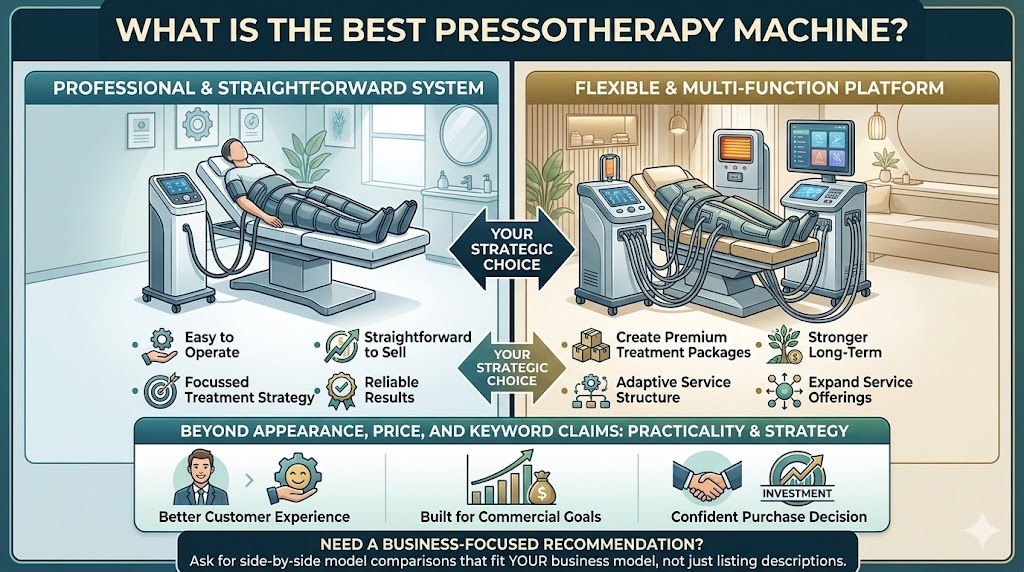
The honest answer is this: the best pressotherapy machine is the one that fits your treatment strategy, staff ability, customer expectations, and commercial goals.
For some businesses, that means a straightforward professional system that is easy to operate and easy to sell. For others, it means a more flexible multi-function platform that helps create premium treatment packages and stronger long-term value.
The key is to stop treating pressotherapy equipment like a simple catalog item. It is a business decision. The right machine should help you deliver a better customer experience, build a stronger service structure, and purchase with more confidence.
That is why serious buyers compare more than appearance, more than price, and more than keyword claims. They compare practicality.
If you are currently reviewing a pressotherapy machine for sale and want a more business-focused recommendation, it is worth asking for side-by-side model comparisons instead of relying only on listing descriptions.
9. Conclusion
Choosing the best pressotherapy machine is not about chasing the most attractive sales page. It is about identifying which machine will work best in a real commercial setting. A strong professional pressotherapy machine should offer practical control, suitable garment coverage, reliable operation, and enough flexibility to support the way your business actually sells treatments. When reviewing any pressotherapy machine for sale, focus on long-term use value, not just entry price. For buyers who want a supplier that understands both equipment and business application, HUIMAIN can be a useful partner in evaluating which configuration fits a salon, spa, clinic, or distribution model more effectively.
10. FAQ Section
1. What is the best pressotherapy machine for a salon or spa?
The best option is usually a machine that balances easy operation, adjustable treatment settings, durable accessories, and enough service flexibility to fit your business. It should match your actual treatment menu rather than simply offering the longest function list.
2. What should I look for in a professional pressotherapy machine?
Look for adjustable pressure and timing, practical garment coverage, user-friendly controls, stable build quality, and a configuration that suits repeat commercial use. Supplier support is also important.
3. Is a multi-function machine better than a standalone pressotherapy machine?
It depends on your business model. A standalone machine can be ideal for simple service menus and lower initial investment. A multi-function platform may be better if you want broader package design, service layering, and higher-value treatment positioning.
4. How do I compare a pressotherapy machine for sale from different suppliers?
Do not compare only by price. Compare treatment flexibility, included accessories, interface usability, durability, supplier communication, customization options, and after-sales support.
5. Is pressotherapy equipment suitable for clinics as well as salons?
Yes, many clinics, spas, and salons use pressotherapy-related equipment in aesthetic and wellness service settings. The right model depends on the type of client experience, treatment positioning, and operational workflow you want to build.
6. Can I request OEM or private label options for a pressotherapy machine?
Many professional beauty machine manufacturers support OEM or private label cooperation. If branding matters for your market, it is worth asking early in the inquiry process rather than after the machine has already been selected.
A71立式冷波
Who is this Onda Coolwave Machine suitable for?
It is suitable for professional aesthetic clinics, beauty salons, and body sculpting centers.
14 in 1
How long is a typical treatment session?
Each session is designed to be short and efficient, lasting only 20 minutes to provide clear facial contours.
KLS
What is the main working principle of the Gold RF Microneedle machine?
The machine works by radiating high-frequency heat through insulated microneedles. This heat causes the collagen layer of the dermis to shrink and coagulate. Through natural healing processes, the dermis is reshaped, and the production of new collagen and elastin begins.
10-in-1 cavitation vacuum machine
How soon can users see results?
Many clients notice changes after 1–3 sessions, with optimal results after 6–12 treatments.
OL-153
What makes OL-153 different from other facial machines?
It combines Hydro Dermabrasion + Oxygen Spray + Water Oxygen Therapy in one system, delivering visible results and improved efficiency for salons and spas.


Get more information
If you have any comments or good suggestions, please leave us a message; later our professional staff will contact you as soon as possible.
Let's Talk
Stay in touch with us for cutting-edge beauty solutions, professional guidance, and customized service.
Contact


Room 307, Building A, Huilong International E-commerce Industrial Park, No. 10 Xipengling Road, Helong Street, Baiyun District, Guangzhou, China
© 2025 HUIMAIN. All Rights Reserved. Privacy Policy | Terms and Conditions | Sitemap
Facebook
Instagram
Medical beauty equipment factory
huimain Medical beauty equipment factory
beauty machine supplier
Whatsapp: +8619124004543