


How Do You Choose the Right Commercial EMS Body Sculpting Machine for Different Body Contouring Treatments?
Quick Answer
Select a commercial ems body sculpting machine by matching the intended treatment objective, applicator geometry, adjustable waveform parameters, user controls, and regulatory documentation. HUIMAIN can support OEM and ODM projects, but buyers should also assess serviceability, training, total cost of ownership, and site conditions. The final configuration depends on project testing, target-market rules, and operating requirements.
How HUIMAIN Supports Projects
HUIMAIN develops professional beauty machines and home-use devices through dedicated purchasing, clinical testing, and engineering departments. For body-contouring equipment projects, its OEM and ODM approach can support product configuration, branding, enclosure requirements, control interfaces, and production planning for salons or distributors. The company operates from a 3,000-square-meter facility and reports CE certification, SGS approval, and patents associated with its product portfolio.
Before quotation, buyers should confirm treatment objectives, body-area applicators, electrical input, control parameters, user interface, documentation, packaging, and target-market requirements. MOQ, lead time, testing scope, after-sales arrangements, and quotation must be confirmed for each project rather than assumed from a standard catalog model.
Discuss Your Body Contouring Equipment Requirements
Send the target market, intended treatment areas, treatment objectives, expected daily usage, facility power conditions, preferred branding or enclosure changes, and required certifications. HUIMAIN can then discuss suitable platform options, sample evaluation, protocol-development boundaries, documentation, and production steps. Visit www.huimainbeauty.com and email coco@huimainbeauty.com to begin a project-specific equipment review.
Frequently Asked Questions
How should operators match EMS output to treatment goals?
Start with the intended physiological objective and the manufacturer’s permitted use, not with a headline intensity number. Electrical muscle stimulation is delivered through a waveform defined by variables such as frequency, pulse duration, amplitude, ramp time, and duty cycle. These variables influence contraction characteristics, comfort, fatigue, and skin or electrode loading. A higher displayed level is not automatically a better contouring protocol, and values from two brands may not be comparable because measurement methods and load conditions differ. Buyers should request the waveform description, adjustable ranges, output limits, contact-detection behavior, emergency stop function, and recommended progression logic. Operators also need screening procedures for contraindications and a clear distinction between cosmetic positioning and medical claims. Protocols should be validated through supervised use on the actual applicator and body area before commercial rollout.
Can one EMS platform treat abdomen, glutes, and limbs safely?
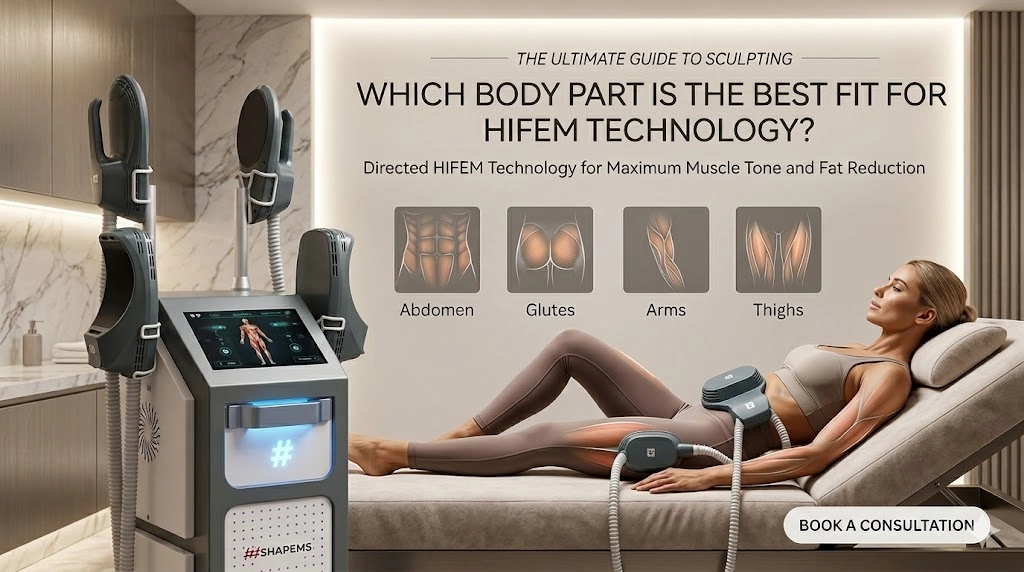
One platform may support several anatomical areas, but that does not mean one applicator or one protocol is appropriate for all of them. Abdomen, gluteal, thigh, and arm areas differ in curvature, tissue thickness, muscle orientation, contact conditions, and patient tolerance. A credible multi-area system should provide applicators that maintain stable contact without excessive pressure and controls that allow treatment-specific timing and intensity adjustments. The operator must position electrodes or applicators according to the supplied instructions and avoid areas where stimulation is unsuitable, including regions affected by implanted electronic devices or other manufacturer-listed exclusions. Buyers should request area-specific instructions, photographs or diagrams, cleaning procedures, and evidence that the accessories were assessed with the main console. Local laws may also classify intended uses differently.
Which applicator design matters for different body areas?
Applicator design affects contact consistency, positioning repeatability, hygiene, cable management, and the distribution of electrical energy across the treatment interface. Buyers should examine the contact surface, flexibility, attachment method, electrode spacing, connector durability, fastening system, and compatibility with the body area. A rigid accessory may not conform well to a curved abdomen, while an unstable attachment can produce inconsistent contact and uncomfortable hot spots. The design should also permit inspection and cleaning of surfaces that touch skin or coupling materials. Ask the supplier whether replacement applicators and cables are available separately and whether accessory changes alter the approved operating instructions. Do not select an accessory solely because it appears larger; usable contact, controlled placement, and repeatable treatment setup are more important than visible coverage.
What electrical specifications should buyers verify before ordering?
Request a complete electrical specification rather than only a maximum intensity figure. Important details include output waveform, pulse frequency, pulse width, amplitude or current limits, channel count, channel independence, ramp settings, duty cycle, session timer, load assumptions, and the behavior of the system when contact is poor. Input voltage, frequency, plug type, power consumption, fuse requirements, and electromagnetic compatibility are also relevant for installation and international distribution. IEC 60601-1 is widely used as a general standard for the basic safety and essential performance of medical electrical equipment, while IEC 60601-1-2 addresses electromagnetic compatibility; applicability depends on product classification and market. A buyer should obtain test reports or declarations relevant to the actual model, not a generic document for a different platform. Displayed intensity should be interpreted only with the supplier’s measurement definition.
How do treatment protocols affect machine selection and training?
A console is commercially useful only when its controls support a reproducible operating procedure. Review how users select body area, waveform, intensity progression, contraction-rest cycles, session duration, contraindication checks, and post-treatment cleaning. Preset programs can improve consistency, but they should not replace operator assessment or permit unreviewed medical claims. Training should cover skin inspection, applicator placement, contact verification, comfort monitoring, stop criteria, documentation, and incident escalation. Buyers should ask for operator manuals, installation guidance, troubleshooting instructions, protocol boundaries, and training materials in the languages required by their market. A pilot with representative staff can reveal whether the interface causes selection errors or whether setup takes too long for the planned workflow. Treatment claims, labeling, and advertising must be reviewed against the destination country’s regulatory framework before launch.
Which compliance and service documents should distributors request?
Distributors should request documents tied to the exact model, accessories, electrical version, and intended market. The package may include a declaration of conformity where applicable, relevant certification evidence, electrical and EMC test documentation, risk-related information, user and service manuals, labeling artwork, warranty terms, packing specifications, spare-parts lists, and traceability details. CE marking is not a universal approval for every market or every claimed use; the applicable European product rules and conformity route depend on classification and intended purpose. SGS documents should also be checked for their specific scope rather than treated as a blanket product endorsement. Commercial planning should include replacement-part availability, response channels, remote troubleshooting limits, repair responsibilities, software or control-panel changes, and escalation procedures. Confirm who owns field-service costs and how nonconforming units are handled before signing a bulk-order agreement.




Get more information
If you have any comments or good suggestions, please leave us a message; later our professional staff will contact you as soon as possible.
Let's Talk
Stay in touch with us for cutting-edge beauty solutions, professional guidance, and customized service.
Contact


Room 307, Building A, Huilong International E-commerce Industrial Park, No. 10 Xipengling Road, Helong Street, Baiyun District, Guangzhou, China
© 2026 HUIMAIN. All Rights Reserved. Designed by Gooeyun. Privacy Policy | Terms and Conditions | Sitemap
Facebook
Instagram
Medical beauty equipment factory
huimain Medical beauty equipment factory
beauty machine supplier
Whatsapp: +8619124004543