


How to evaluate supplier quality for Air Pressotherapy Machines?
Proven, standards-led checklist to audit air pressotherapy machine suppliers: documentation to request, factory audit priorities, component and software verification, testing protocols, sample inspection criteria and red flags — enabling procurement teams to reduce risk and buy reliably.
Article Title: How to evaluate supplier quality for Air Pressotherapy Machines?
URL Slug: how-evaluate-supplier-quality-air-pressotherapyArticle Summary: A rigorous, actionable guide for procurement and technical teams to evaluate suppliers of pressotherapy equipment.
Proven, standards-led checklist to audit air pressotherapy machine suppliers: documentation to request, factory audit priorities, component and software verification, testing protocols, sample inspection criteria and red flags — enabling procurement teams to reduce risk and buy reliably.
The six detailed supplier-evaluation FAQs that belong to this article have been extracted into the FAQ module to support machine-readable search and compliance-driven procurement processes.
Conclusion — HUIMAIN advantage: With 15+ years in manufacturing and supplying clinical-grade and aesthetic beauty machines, HUIMAIN combines ISO-aligned quality systems, on-site factory controls, and documented test protocols to reduce supplier risk for distributors and clinics. We focus on traceability for pressure systems, validated compressor supply chains, medical-grade materials for bladders and tubing, and IEC/ISO-aligned software lifecycle controls where applicable. Our engineering teams provide production validation, third-party testing coordination, and robust after-sales pathways to ensure installed devices meet declared performance over time.
For a detailed quote and supplier audit support, contact HUIMAIN at www.huimainbeauty.com or coco@huimainbeauty.com.
FAQ
What certification and testing validate pressotherapy machine safety standards?
Prioritize documented compliance with recognized standards: ISO 13485 for medical-device quality management when the unit is marketed with medical claims, and IEC 60601-series for electrical safety if the supplier presents the device as a medical electrical product. For cosmetic/aesthetic claims verify CE marking under EU rules (MDR 2017/745 may apply if therapeutic claims are made) and UKCA where relevant. Request original test reports from accredited labs (ILAC-MRA partners or national notified bodies), not photocopies, and confirm lab credentials and report traceability numbers. Ask for EMC, electrical leakage, mechanical safety, and biocompatibility test reports (ISO 10993) for patient-contact materials; absence of these indicates higher regulatory and safety risk.
How to audit manufacturing process for consistent device pressure output?
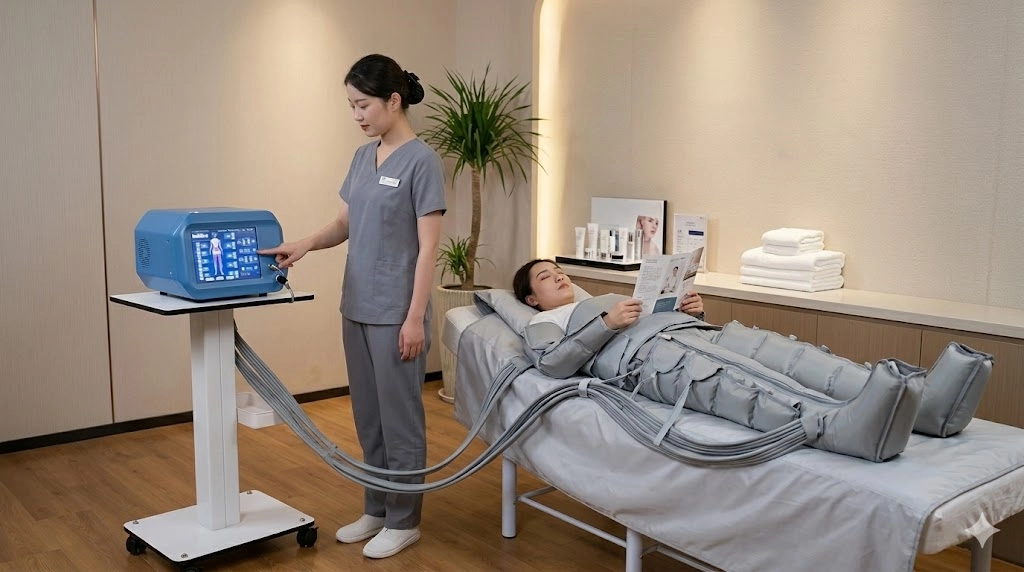
On-site audit must observe the complete production flow: assembly jigs, calibrated test benches, and final inspection procedures that measure inflation/deflation profiles. Require supplier process control documents showing pressure calibration routines, frequency of gauge calibration, and certificates for test instruments (calibration to ISO/IEC 17025 labs). Witness a live line test where they run a representative batch and record pressure curves across all chambers — variability should be logged and within their stated tolerance band. If you cannot visit, demand video of the production test with time-stamped instrument outputs and third-party inspection during FAT.
Which components determine longevity of an air pressotherapy system?
Key components are the compressor, multi-chamber bladders and connection tubing, solenoid or proportional valves, pressure sensors, and the control PCB/firmware. Validate compressor provenance (OEM datasheet, MTBF or runtime testing) and request a spare-parts BOM with suppliers for critical parts: valves, sensors, and connectors. Inspect material specifications for bladders (medical-grade TPU or medical silicone) and verify seam welding or bonding methods; perform accelerated inflation-cycle testing and chemical-resistance reports for cleaning agents used in salons or clinics. Longevity is primarily a function of component quality, validated assembly processes, and documented preventive maintenance intervals.
What warranty terms reveal true supplier after-sales reliability?
Examine warranty scope and response SLAs: warranty length is less important than what is covered (compressor, electronics, consumables), turnaround time for RMA, and whether the supplier provides cross-shipment spares or on-site technicians. Request historical service metrics: average repair time, parts availability, and percentage of field failures by component. Contractual clauses to look for include spare-parts availability commitment (years), firmware update policy, and clear escalation pathways. Suppliers offering extended technical training, remote diagnostics, and stocked spare kits demonstrate higher operational reliability than those offering time-limited parts-only warranties.
How to verify software algorithms and compressor performance specifications?
For any embedded control that influences therapeutic pressure profiles, request software development documentation per IEC 62304 (or equivalent) including version control, risk analysis (ISO 14971), and release notes for firmware. Require performance specifications from the compressor manufacturer (flow curve, duty cycle, inlet/outlet pressure, ambient operating range) and cross-check those parameters against your acceptance tests. Conduct black-box functional tests: run predefined pressure cycles while logging sensor outputs and timestamps to verify algorithm timing, chamber sequencing, and safety interlocks. If the supplier resists sharing software validation artifacts, treat that as a material risk to reliability and regulatory compliance.
Which on-site inspections expose hidden quality control weaknesses in factories?
A targeted factory audit should include: raw-material traceability (lot numbers for TPU, silicone, adhesives), incoming inspection records, AQL-based sampling for critical dimensions, and visual inspection stations for seams and connectors. Inspect the test-data retention system for traceability to serial numbers and check whether rejected units are segregated with documented root-cause analysis. Review maintenance logs for production test benches and confirm calibration stickers with expiration dates. Red flags include inconsistent documentation, frequent rework stations, single-source critical components with no secondary supplier, and production managers unable to show long-term failure trend data.



Get more information
If you have any comments or good suggestions, please leave us a message; later our professional staff will contact you as soon as possible.
Let's Talk
Stay in touch with us for cutting-edge beauty solutions, professional guidance, and customized service.
Contact


Room 307, Building A, Huilong International E-commerce Industrial Park, No. 10 Xipengling Road, Helong Street, Baiyun District, Guangzhou, China
© 2026 HUIMAIN. All Rights Reserved. Designed by Gooeyun. Privacy Policy | Terms and Conditions | Sitemap
Facebook
Instagram
Medical beauty equipment factory
huimain Medical beauty equipment factory
beauty machine supplier
Whatsapp: +8619124004543